
Recruitment
Best ATS for Recruiters in 2026: 15 Systems Compared
Compare the 15 best applicant tracking systems for recruiters in 2026: verified pricing, AI features, G2 ratings, and picks for agencies, SMBs and enterprise.
The Global Embedded RPO Company

G2 lists 606 applicant tracking systems as of September 2026, with an average rating of 4.46 out of 5. You need one of them, and the ratings will not tell you which.
By the Matchr team. Updated September 2026: prices, ratings and ownership checked on 29 September 2026.
An ATS is the software your hiring runs on: where roles get posted, applications land, candidates move through stages, and your team decides who to hire. The right one makes hiring feel calm and organised. The wrong one becomes the thing everybody works around.
There is no single best ATS. The system that fits a 40-person startup is a poor fit for a 10,000-person enterprise, and the tool built for a staffing agency billing contractors is not the tool an in-house team needs. So this guide does three things most lists do not.
First, it compares 15 systems on what separates them: who they are built for, what they cost, how much of their AI has actually shipped, and what their own users say on G2 and Capterra. Every price was checked against the vendor's pricing page in September 2026, with the billing unit stated plainly and quote-only systems marked as such, because pricing is where comparison articles quietly go out of date.
Second, it shows which systems companies actually run. Jobscan's 2026 usage report found a detectable ATS at 97.4% of Fortune 500 companies, with Workday alone on more than 40% of them. Across a broader set of 13,130 companies, the same report puts Greenhouse first at 19.0%, then Workday at 17.5%, Lever at 15.6% and iCIMS at 14.4%. Popularity is a signal, not a verdict, and we explain the difference.
Third, it names who owns whom. Lever and JazzHR share a parent in Employ Inc., SmartRecruiters has belonged to SAP since the acquisition closed on 11 September 2025, and Breezy HR sits inside Learning Technologies Group. That changes how you should read three "rival" entries on the same shortlist.
As a global embedded RPO partner, we at Matchr work inside whatever system our clients run, so this list is shaped by hands-on use across most of these platforms rather than by vendor demos. We run Ashby ourselves, and we say so where it matters.
If you only have two minutes: the comparison table is next, the quick picks by use case follow it, and the pricing section further down answers the question most buyers actually have. Everything else is detail for when you have a shortlist.
The 15 best ATS for recruiters in 2026, at a glance
Starting prices are the lowest public entry point on the vendor's own pricing page, checked on 29 September 2026. "Quote" means the vendor publishes no price. G2 scores were captured the same week; the full ratings table, with Capterra and review counts, is further down.
| System | Best for | Starting price | Free option | AI maturity | G2 score | Parent group |
|---|---|---|---|---|---|---|
| Ashby | Scale-ups and tech teams | $300 a month (1 to 10 employees) | No | Shipped | 4.7 | Standalone |
| Greenhouse | Structured mid-market and enterprise hiring | Quote | No | Shipped | 4.4 | Standalone |
| Workable | SMB and mid-market all-in-one | $299 a month (1 to 20 employees) | No | Shipped, credit-metered | 4.4 | Standalone |
| Lever | ATS plus sourcing CRM | Quote | No | Shipped | 4.3 | Employ Inc. |
| Teamtailor | Employer-brand-led teams | Quote | No | Shipped | 4.6 | Standalone |
| Pinpoint | UK and EU mid-market in-house teams | Quote | No | Shipped | 4.6 | Standalone |
| Manatal | Agencies and SMBs on a budget | $15 per user a month | No | Shipped | 4.8 | Standalone |
| Recruit CRM | Recruitment and search agencies | Per user, shown on the vendor page | No | Shipped, credit-metered | 4.8 | Standalone |
| Bullhorn | Staffing agencies at scale | $99 per user a month | No | Shipped on Pro and up | 4.2 | Standalone |
| JazzHR | First ATS for small business | $1,000 a year | No | Basic matching | 4.4 | Employ Inc. |
| Zoho Recruit | Value SMBs and small agencies | $25 per recruiter a month | Yes, one active job | Shipped on Enterprise | 4.4 | Zoho |
| BambooHR | HR suite with a light ATS | Quote | No | HR assistant only | 4.4 | Standalone |
| SmartRecruiters | High-volume enterprise, SAP shops | $14,995 a year | No | Shipped, tier-gated | Not shown | SAP |
| iCIMS | Large, complex enterprises | Quote | No | Shipped, agents rolling out | 4.2 | Standalone |
| Recruitee | Collaborative EU teams | Quote | No | Shipped, credit-metered | 4.5 | Tellent (PSG Equity) |
Sources for the table: vendor pricing pages linked in the pricing section, G2's ATS category and product review pages, and the SAP announcement for SmartRecruiters. G2's SmartRecruiters page showed no product score when we checked, so we print none rather than an old one.
How to read it, in four lines:
- Prices move as plans change. Treat every figure as the start of your own quote, not a promise.
- Quote-only is normal at the mid-market and enterprise end. We say so rather than repeat a third-party estimate as fact.
- A high score from agency recruiters tells an in-house enterprise team very little. Read the "best for" column first.
- Ownership matters more than it looks. Lever and JazzHR are both Employ Inc. brands (so is Jobvite), SmartRecruiters is SAP's since the deal closed on 11 September 2025, Recruitee trades as Tellent Recruitee under PSG Equity, and Breezy HR sits inside LTG. Three "rivals" on one shortlist can be one company.
Best ATS by use case: the quick picks
If you read nothing else, this is where each system most often wins the shortlist, in the stacks our embedded recruiters work inside.
- Scale-ups and tech teams: Ashby for analytics depth (it is also the ATS we run at Matchr, so weigh that), or Workable for published pricing and a fast start.
- Enterprise: Greenhouse for structured, governed hiring; iCIMS and SmartRecruiters for high volume and complex compliance. If your company already runs Workday or SuccessFactors, the choice may already be made (see the enterprise section).
- Staffing and recruitment agencies: Bullhorn at scale, Recruit CRM for growing search firms, Manatal when budget leads the decision.
- Small business buying a first ATS: JazzHR for flat-rate simplicity, Zoho Recruit for value and a free plan, Breezy HR when a free plan with unlimited users matters most.
- Employer-brand-led teams: Teamtailor and Pinpoint, both strong in the UK and EU, with careers sites that do real work.
- HR-suite buyers: BambooHR, where applicant tracking is one module of a wider HR platform rather than a recruiting system in its own right.
Now the detail, with the numbers and the honest watch-outs.
Which ATS do companies actually use? Market share in 2026
The most used ATS in the world is missing from most "best ATS" lists, and that tells you something about how those lists are written.
Jobscan reverse-engineers the careers pages of every Fortune 500 company each year. In its 2026 report, it detected an ATS at 487 of the 500, or 97.4%. Workday runs hiring at more than 40% of those companies and SAP SuccessFactors at 12%, so two HCM suites cover 52.4% of the largest employers in the United States between them. iCIMS holds its ground in that group while Oracle Taleo keeps shrinking, per the same report.
Outside the Fortune 500 the picture changes completely. Across 13,130 companies where Jobscan's scanner detected an ATS, Greenhouse leads at 19.0%, followed by Workday at 17.5%, Lever at 15.6% and iCIMS at 14.4%. Those four systems account for about two thirds of the sample. That is the market most recruiters reading this actually hire in.
Agencies run on a different set again. Bullhorn reports more than 10,000 customers and calls itself the category default for staffing, and it is hard to argue with. Crelate cites 25,000-plus professionals on its platform, and Zoho says over 800,000 recruiters build teams with Zoho Recruit, a figure that includes its free tier.
Why "most used" is not "best for you"
Workday and SuccessFactors dominate the Fortune 500 because they are bought as part of an HR suite decision, usually by finance and IT, not by the talent team. Neither appears in our 15 for that reason: if your company runs Workday HCM, you will almost certainly run Workday Recruiting, and no comparison article changes that. The choice recruiters actually get to make sits in the mid-market and agency segments, which is where this guide spends its time.
Every system on the market, grouped
If you want the names rather than the verdicts, this is the map. Systems in bold are reviewed in detail below.
- Enterprise HCM suites with recruiting built in: Workday Recruiting, SAP SuccessFactors Recruiting, Oracle Recruiting (and legacy Taleo), UKG.
- Enterprise talent acquisition suites: iCIMS, SmartRecruiters, Jobvite, Avature, Phenom, Eightfold, Paradox (conversational AI, usually layered on another ATS).
- Mid-market in-house systems: Greenhouse, Lever, Ashby, Teamtailor, Pinpoint, Recruitee, Workable.
- Small business and first-ATS buyers: JazzHR, Zoho Recruit, BambooHR (an HR suite with a light ATS), Breezy HR, Rippling (an add-on to its HR platform).
- Staffing and recruitment agencies: Bullhorn, Recruit CRM, Manatal, Crelate, JobDiva, Ceipal, Loxo, Vincere, JobAdder.
G2's category average is 4.46 out of 5 across 606 products, which is the clearest evidence that star ratings alone will not separate them. Fit will. For the wider numbers behind hiring in 2026, see our recruitment statistics hub.
ATS comparison: how the 15 stack up feature by feature
Feature lists are where every ATS looks the same, so this grid only marks the things that separate them in daily use. "Strong" means the capability is a reason teams pick the system; "Yes" means it is there and works; "Add-on" means you pay extra; "Light" means it exists but will not carry a demanding team. The ratings behind it come from the vendor feature and pricing pages linked in each review, and from what we see inside client stacks.
| System | Sourcing and CRM | Scheduling | AI screening | Reporting | Careers site | Agency billing |
|---|---|---|---|---|---|---|
| Ashby | Strong | Strong (add-on for complex loops) | Yes | Strong | Yes | No |
| Greenhouse | Yes | Yes | Yes | Light | Yes | No |
| Workable | Yes | Yes | Yes, credit-metered | Light | Yes | No |
| Lever | Strong | Yes | Add-on | Light | Yes | No |
| Teamtailor | Yes | Yes | Yes | Yes | Strong | No |
| Pinpoint | Yes | Yes | Yes | Yes | Strong | No |
| Manatal | Yes | Yes | Yes | Light | Yes | Light |
| Recruit CRM | Strong | Yes | Yes, credit-metered | Yes | Light | Strong |
| Bullhorn | Strong | Yes | Pro tier and up | Yes | Light | Strong, with pay and bill |
| JazzHR | Light | Yes | Light | Light | Yes | No |
| Zoho Recruit | Yes | Yes | Enterprise tier | Yes | Yes | Yes (staffing edition) |
| BambooHR | Light | Light | No | Light | Yes | No |
| SmartRecruiters | Yes | Yes | Tier-gated | Yes | Yes | No |
| iCIMS | Strong | Yes | Yes | Yes | Strong | No |
| Recruitee | Yes | Yes | Yes, credit-metered | Yes | Yes | No |
Three patterns stand out. Reporting is the weakest area across the mid-market, which is why Ashby's analytics win so many scale-up shortlists. AI screening now exists almost everywhere, but three systems here meter it with credits, and for those the price you see is not the price you pay. And only three systems here are built for agency work (Bullhorn, Recruit CRM and Zoho Recruit's staffing edition), with Manatal close behind; the rest are built for one employer's roles.
Integrations and job-board reach matter as much as anything in the grid. Every system here posts to the main boards and connects to the common calendars, but check the three integrations you use daily (usually the HRIS, the assessment tool and the calendar) before you fall for a feature you might use.
GDPR, data residency and hiring in the EU, UK and the Netherlands
Most ATS comparisons are written for US buyers, and it shows in one place above all: candidate data. If you hire in Europe, the questions below are not a legal footnote. They decide whether the system can be used as configured.
Retention. Under the GDPR you may keep candidate data only as long as you need it for the purpose you collected it for. The Dutch data protection authority, the Autoriteit Persoonsgegevens, publishes specific guidance on applicant data, including how long you may keep it after a procedure and when you need the candidate's consent to keep them in a talent pool. Your ATS must be able to enforce that: automatic deletion or anonymisation after a set period, and a consent request that is logged.
Consent for talent pools and CRM. Sourcing CRMs (Ashby, Lever, Recruit CRM, Bullhorn) are built to keep people on file for future roles. In the EU that needs a lawful basis for every profile you store, and a way for the candidate to see, correct and delete their data. Ask each vendor to show you the candidate-request flow, not just tell you it exists.
Where the data lives. Ask where production data is hosted and which sub-processors see it, and get the data processing agreement before you sign, not after. Several of the systems here are headquartered in Europe (Teamtailor in Sweden, Recruitee in the Netherlands under Tellent, Pinpoint in the UK), which often makes these conversations shorter, but the contract is what counts, not the head office.
AI screening is regulated. The EU AI Act classes AI used to screen, rank or evaluate candidates as high-risk. Under the omnibus agreement, the obligations for those systems apply from 2 December 2027, and the GDPR's rules on automated decisions apply today. Practically: know which AI features are switched on, who reviews their output, and whether a person makes every rejection decision.
Works councils. In the Netherlands and Germany, introducing a system that monitors or evaluates people can require works council consent. Involve them early; a new ATS with AI screening is exactly the kind of change they will ask about.
Our view from inside client teams: the systems built in Europe tend to arrive with these answers ready, and the US-built ones usually have them too, but you have to ask. Put these five points in your request for proposal and you will learn more about a vendor from how they answer than from the demo.
ATS pricing in 2026: what recruiters actually pay
There is no average cost of an applicant tracking system, and any article that gives you one is averaging across four different billing units.
Per user per month. This is the agency norm and the cheapest way in. Manatal starts at $15 per user per month on annual billing, Crelate at $85, Bullhorn at $99. Zoho Recruit prices per recruiter with a forever-free tier for one active job, and paid plans from $25 per recruiter per month billed annually.
Per company size band. Workable charges a flat $299 per month for a company of 1 to 20 employees on its Standard plan ($3,588 a year), rising to $599 for Premier and $719 for Enterprise, and steps up through nine employee bands to 1,000-plus. Ashby's Foundations plan shows $400 per month for an 11 to 25 employee company on monthly billing, with 10% off for an annual commitment and quote-only Plus and Enterprise tiers above 100 employees. The smallest band, 1 to 10 employees, is $300 a month.
Flat annual, unlimited users. JazzHR charges $1,000 a year for Hero, $3,480 for Plus and $5,508 for Pro, and yearly billing saves up to 24% against monthly. For a small business with many hiring managers and few recruiters, this is often the cheapest model in practice.
Free plans that are actually free. Breezy HR's Bootstrap plan is free forever for one active position with unlimited users; paid plans start at $157 a month on annual billing ($189 monthly). Zoho Recruit's free edition allows one active job per recruiter licence.
Enterprise. SmartRecruiters is the only enterprise suite here with a public number: its Essential plan starts at $14,995 a year, with Professional, High Volume and Complete on request. Greenhouse publishes no price at all; cost depends on the tier (Core, Plus or Pro), hiring volume and complexity. iCIMS, Lever, Pinpoint, Teamtailor and Recruitee are quote-only too.
The costs that are not on the price list
AI is increasingly metered. Workable's recruiting agent runs on credits: 5,000 credits cost $600, at one credit per candidate screened and ten per chat conversation, on top of the plan. Breezy Intelligence credits start at $30 per 100,000. Recruit CRM meters its AI with credits, even on paid plans. Add-ons stack too: Workable's texting, video interviews and assessments are $89, $109 and $59 a month each on the Standard plan. Enterprise implementation is quoted separately from the licence and no vendor in this list publishes a figure for it, so ask every quote-only vendor for the all-in first-year number, not the sticker.
Three honest reference points, worked from the published prices above: a five-person agency on Manatal Professional pays $75 a month; a 20-employee company on Workable Standard pays $3,588 a year before add-ons; an enterprise on SmartRecruiters starts at $14,995 a year before implementation. Where your team sits between those three tells you more than any average. And if the budget conversation is really about whether you need more software or more recruiting capacity, that is a different question, one we cover in what embedded recruitment costs.
The 15 systems reviewed
Each review opens with where we most often see the system win, then the facts: price as published, the AI that has shipped, what that AI decides and what still needs a person, ratings captured in September 2026, ownership, and the honest watch-outs.
1. Ashby
Where we see it most: high-growth scale-ups and tech teams that want analytics-grade reporting in one platform, though its Plus and Enterprise tiers serve much larger organisations too. This is the ATS we run at Matchr, so read this entry knowing it is our own pick.
Ashby brings ATS, CRM, sourcing, scheduling and analytics into one system. Its reporting answers funnel questions most systems make you export to a spreadsheet to figure out.
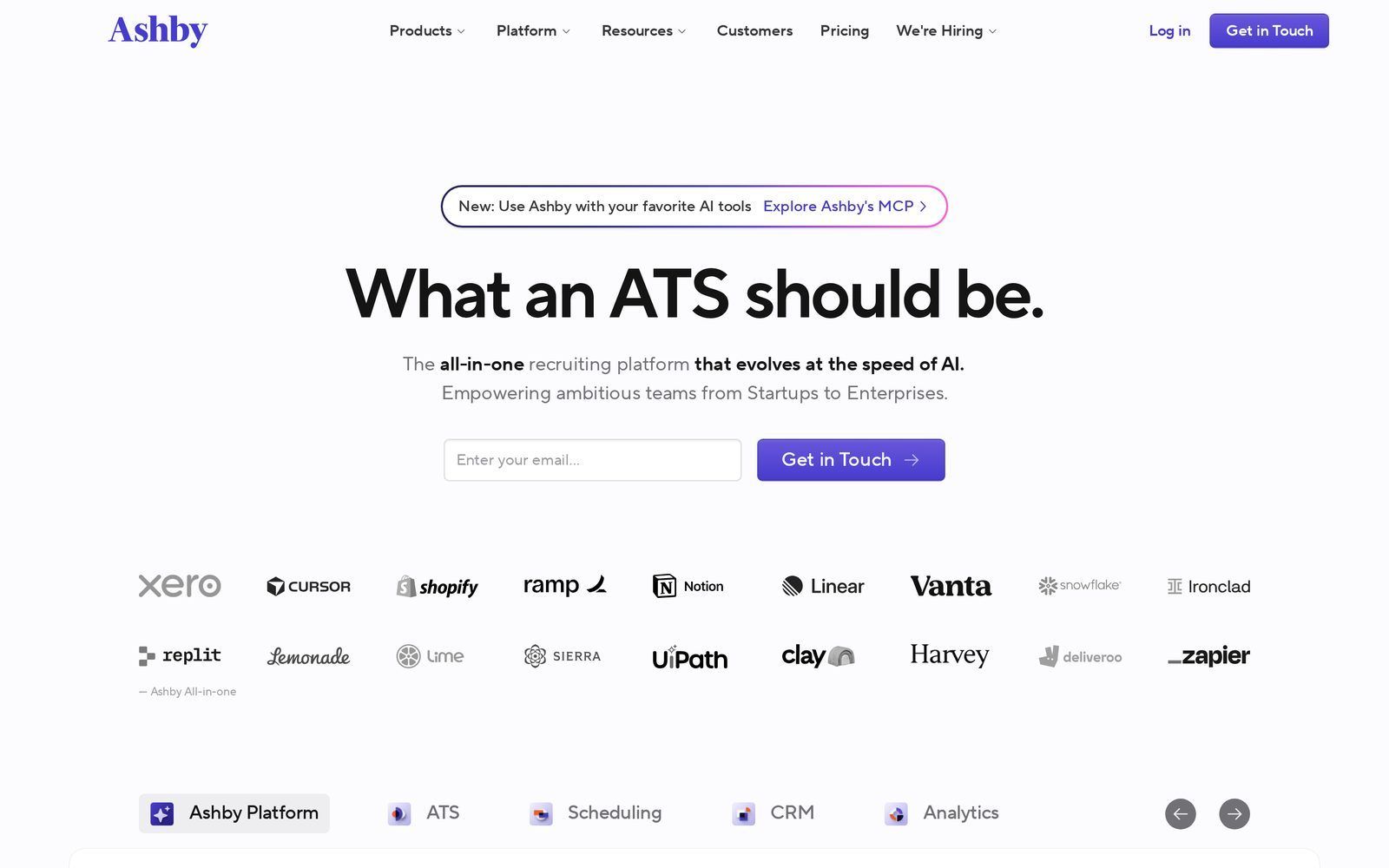
- Price: Foundations is $300 a month for 1 to 10 employees and $400 for 11 to 25, with 10% off for an annual commitment. Plus and Enterprise are quote only.
- AI in 2026: an AI Notetaker that records, transcribes and summarises interviews (a paid add-on), AI inside analytics, and candidate matching and scoring. Sourcing AI is the weaker area.
- What the AI decides, what a person decides: the AI drafts the interview summary and suggests a match score. The hire or no-hire call, and the calibration of what "good" means for the role, stay with the hiring team.
- Ratings: G2 4.7 (190 reviews), Capterra 4.4 (15 reviews).
- Watch for: cost climbs with company size, and Capterra's review base is still small.
- Matchr verdict: the strongest reporting on this list. Worth the premium if your team will actually use the data.
2. Greenhouse
Where we see it most: mid-market and enterprise in-house teams that want structured, governed hiring and will pay for it.
Greenhouse has set the standard for structured hiring for years: interview kits, scorecards and a process that keeps hiring managers consistent. Its integration library is one of the deepest in the category.
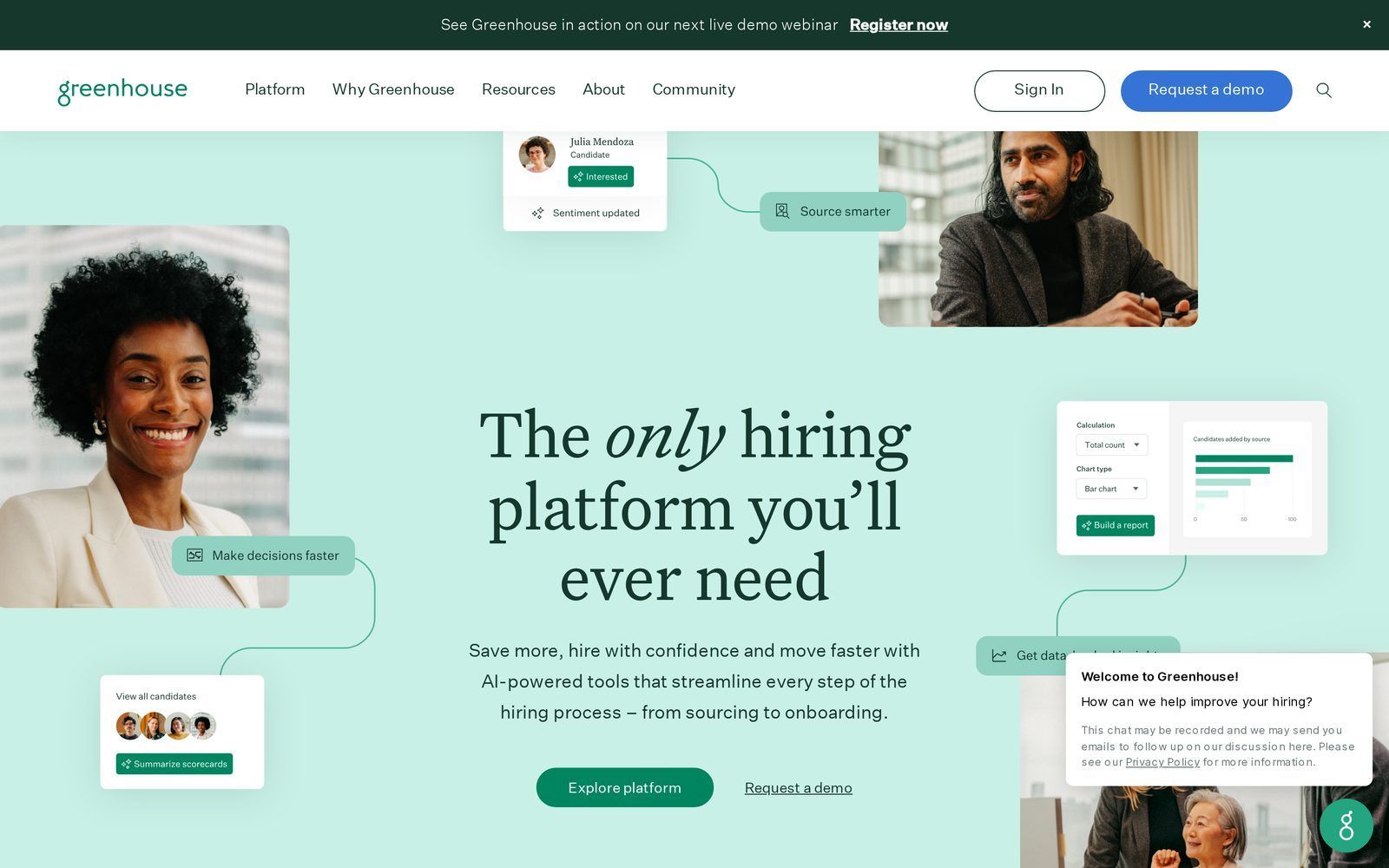
- Price: quote only, across Core, Plus and Pro, priced by hiring volume and complexity.
- AI in 2026: "Real Talent" candidate matching, sourcing automation, suggestions for scorecards and job posts, and fraud and identity verification on higher tiers.
- What the AI decides, what a person decides: the AI flags likely matches and suspicious applications. Whether a flagged candidate is rejected, and whether a scorecard reflects the role, are human calls.
- Ratings: G2 4.4 (3,956 reviews), Capterra 4.5 (765 reviews).
- Watch for: reviewers find reporting limited and the interface click-heavy, and the cost is hard to justify below a few hundred employees.
- Matchr verdict: the safest choice for a company that wants hiring to run the same way in every team.
3. Workable
Where we see it most: SMB and mid-market teams, roughly under 200 employees, that want an all-in-one system with a fast start and wide job-board reach.
Workable is the system most associated with getting live quickly, and its 2026 headline is an AI recruiting agent that sources, screens and chats with candidates.
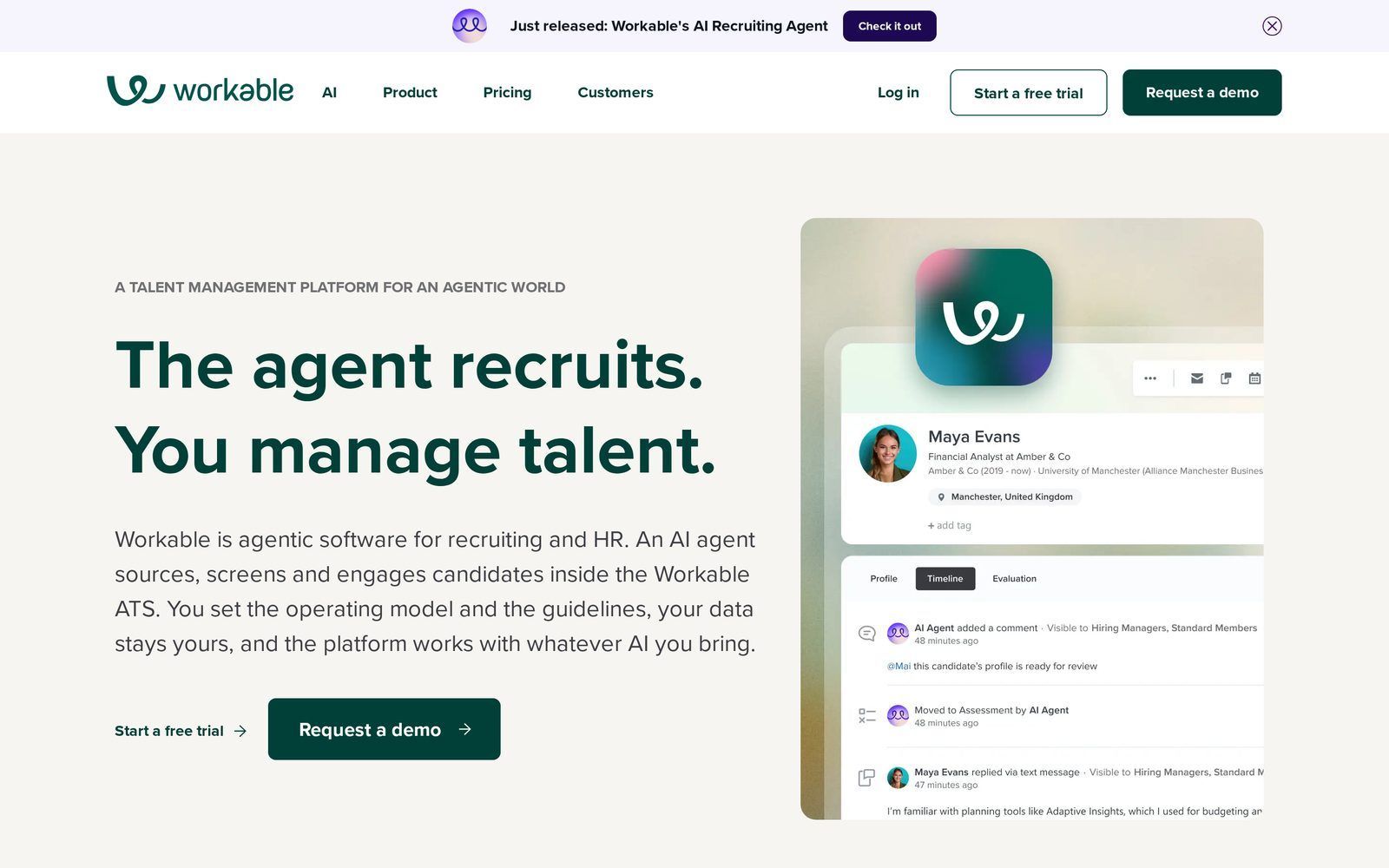
- Price: flat monthly by company size, not per user. For 1 to 20 employees: Standard $299, Premier $599, Enterprise $719 a month. AI credits cost extra: 5,000 credits for $600.
- AI in 2026: the AI Recruiting Agent sources from a large candidate database, screens inbound applicants and chats with candidates to fill gaps, plus AI writing for job posts and emails.
- What the AI decides, what a person decides: the agent decides who gets surfaced and screened in. Deciding who is rejected, and checking the agent is not screening out good people for the wrong reasons, is a recruiter's job.
- Ratings: G2 4.4 (688 reviews), Capterra 4.4 (662 reviews).
- Watch for: credit spend on busy roles, recurring reports of slow syncs, and light reporting.
- Matchr verdict: the most transparent pricing on the list and a good first serious ATS.
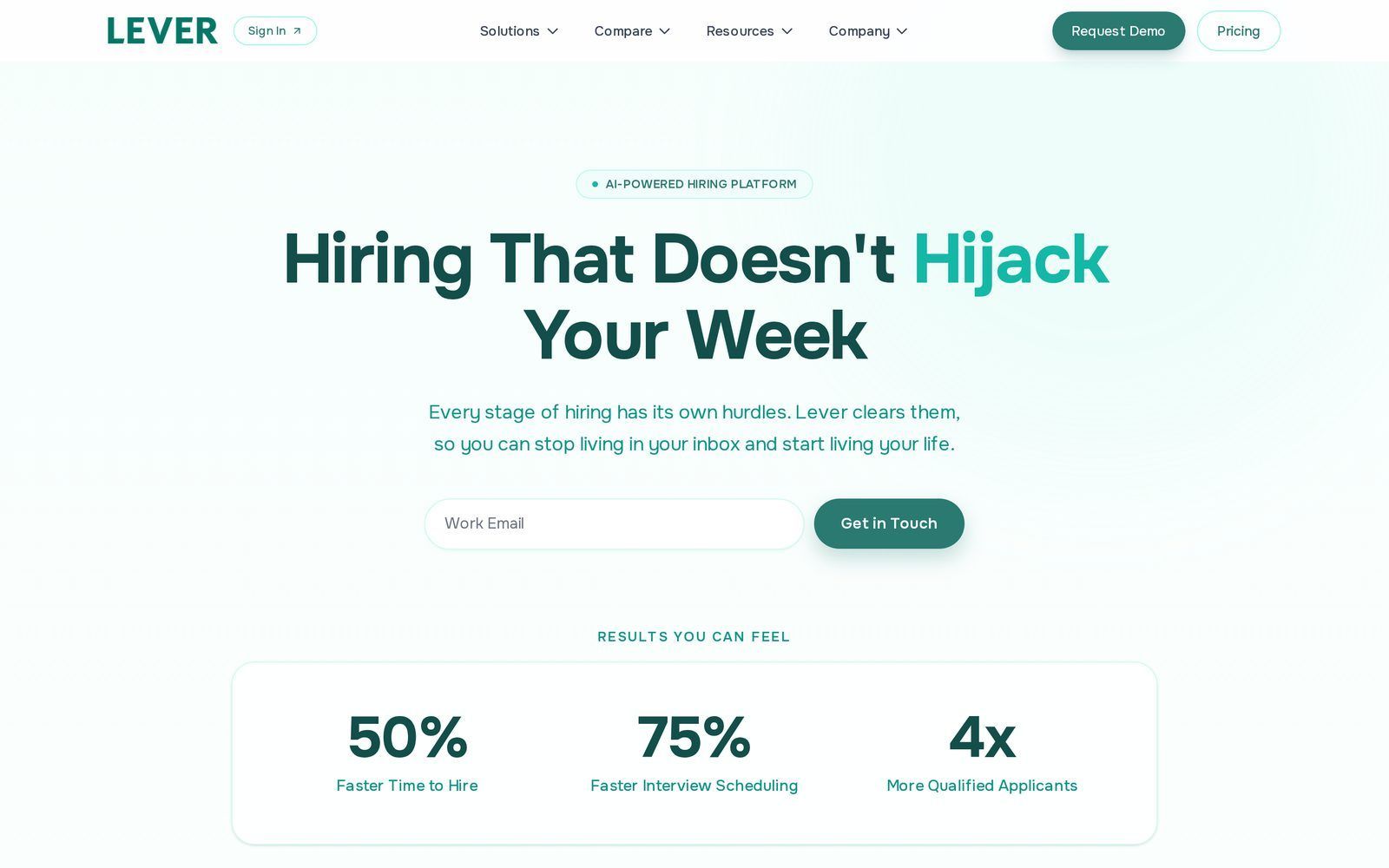
4. Lever
Where we see it most: mid-market talent teams that want an ATS and a sourcing CRM in one, with strong hiring-manager adoption.
Lever pairs applicant tracking with candidate nurture, which suits teams that build relationships over time rather than only processing inbound applications.
- Price: quote only, scaling by team size, with add-ons for candidate insights, AI screening and onboarding.
- AI in 2026: AI screening and matching signals, unlimited AI interview transcripts and summaries, and an agentic careers-site screening add-on.
- What the AI decides, what a person decides: the AI screens and summarises. Who moves forward from a nurture campaign into a live process, and when, stays with the recruiter.
- Ratings: G2 4.3 (2,124 reviews), Capterra 4.6 (654 reviews).
- Ownership: an Employ Inc. brand since 2022, alongside JazzHR and Jobvite.
- Watch for: reviewers mention limited reporting and uneven support, and e-signature needs a paid DocuSign connection.
- Matchr verdict: strong if sourcing and nurture are how you hire. Know the parent before you compare it with JazzHR.
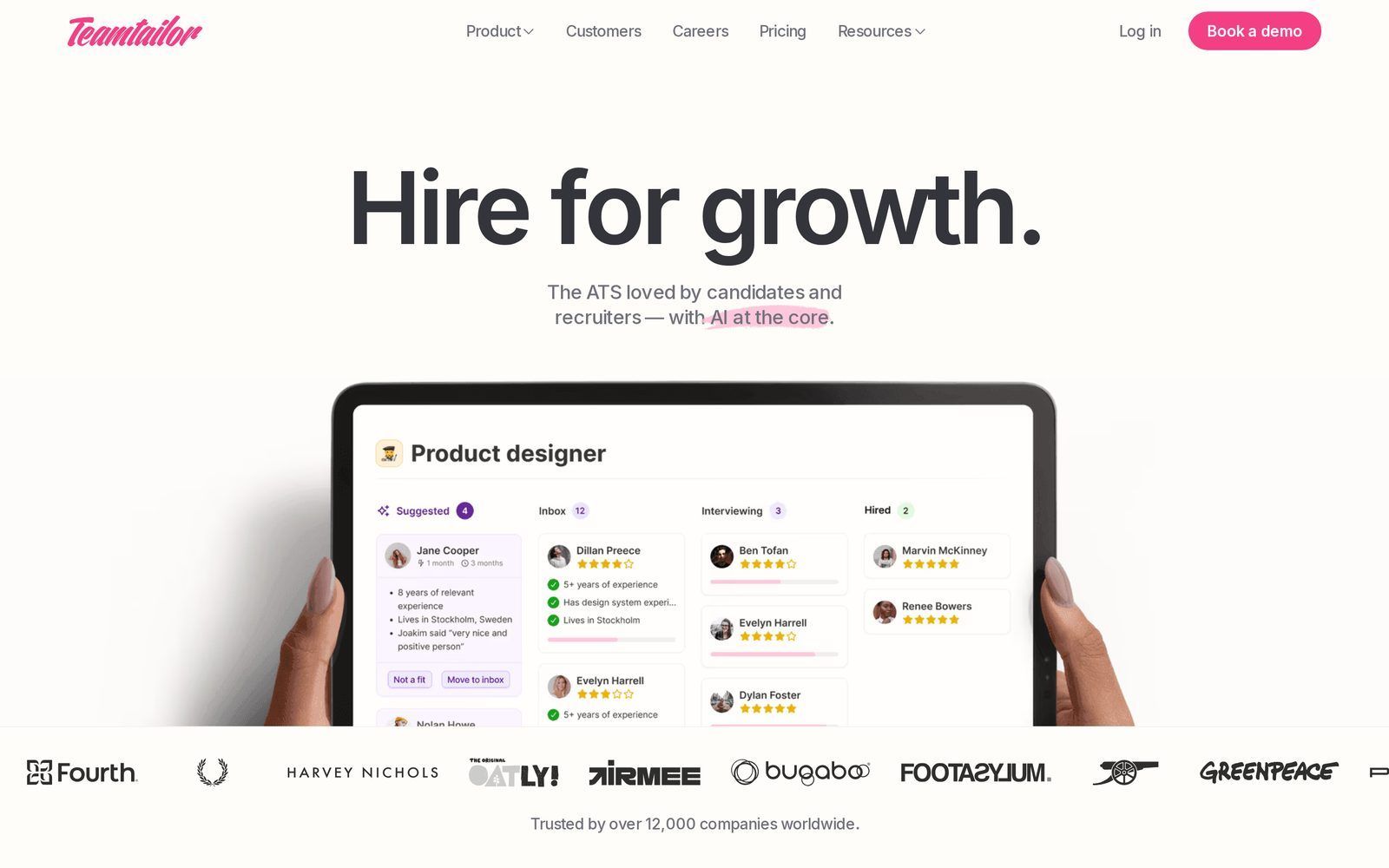
5. Teamtailor
Where we see it most: SMB to mid-market teams that lead with employer brand and want a well-designed careers site attached to the ATS.
Teamtailor is built around the candidate-facing experience: branded career pages, content and a workflow that marketing-minded talent teams enjoy using.
- Price: quote only, typically with unlimited users included.
- AI in 2026: a Co-pilot for candidate summaries, job-ad drafting, interview questions and natural-language reports.
- What the AI decides, what a person decides: the Co-pilot writes and summarises. The story your careers site tells, and who you interview, are decisions the team keeps.
- Ratings: G2 4.6 (563 reviews), Capterra 4.6 (112 reviews).
- Watch for: reviewers mention a cramped CV viewer, occasional calendar-sync bugs and limited customisation without custom CSS.
- Matchr verdict: the best careers-site experience here, especially for European employers.
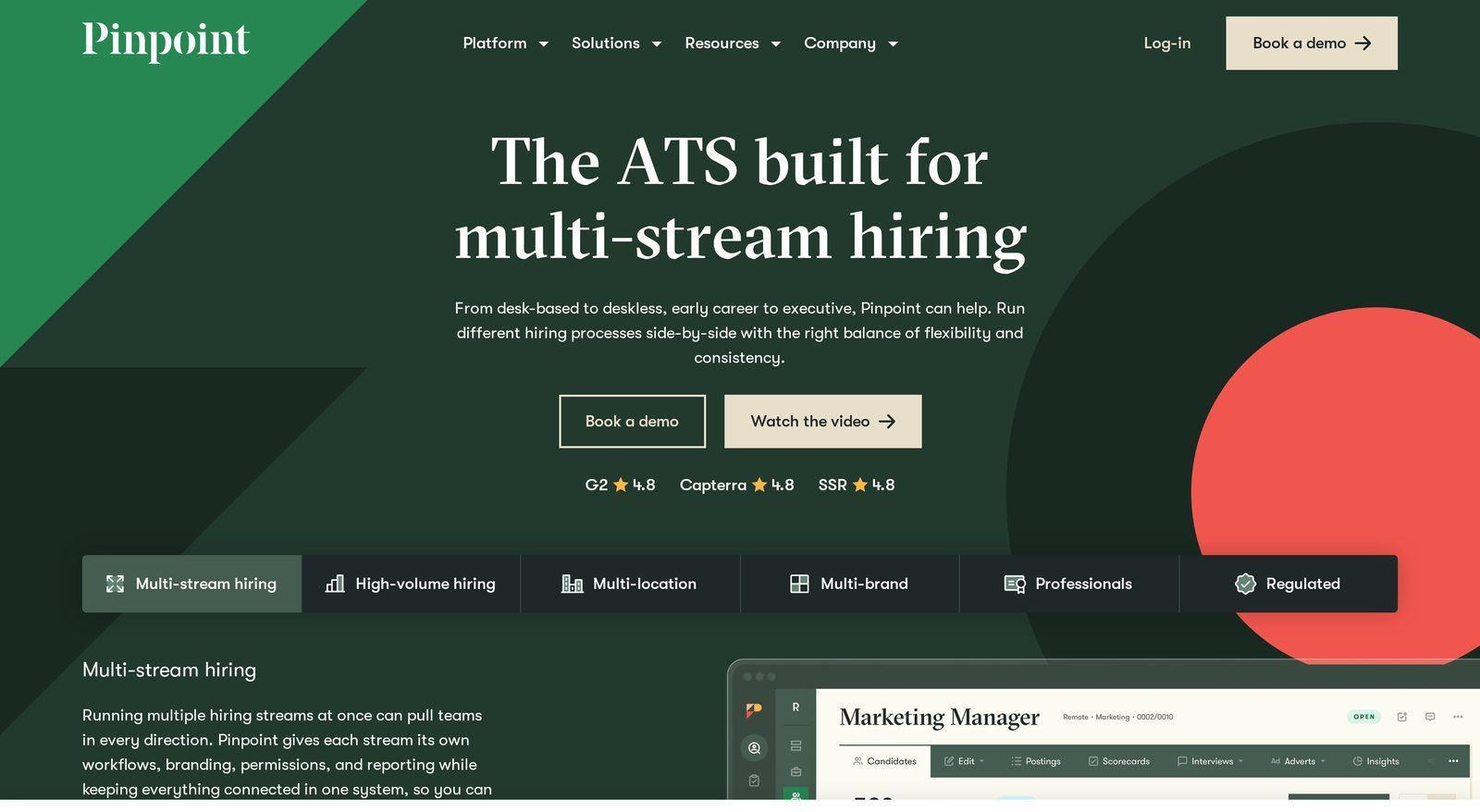
6. Pinpoint
Where we see it most: UK and EU in-house teams at mid-market size that care about candidate experience and GDPR-grade compliance.
Pinpoint is strong on branded careers sites, onboarding and running several hiring streams at once, from high volume to executive search.
- Price: quote only, positioned mid-market.
- AI in 2026: an AI Candidate Companion (a careers-site chatbot that answers questions and routes candidates to roles), generative content and AI-assisted CV screening.
- What the AI decides, what a person decides: the chatbot decides which role a candidate is pointed to. The shortlist, and every rejection, should still pass a recruiter's eyes.
- Ratings: G2 4.6 (165 reviews), Capterra 4.7 (91 reviews).
- Watch for: reporting can lag at large candidate volumes, and e-signature needs the paid onboarding module.
- Matchr verdict: the in-house ATS we most often see chosen for European compliance comfort.
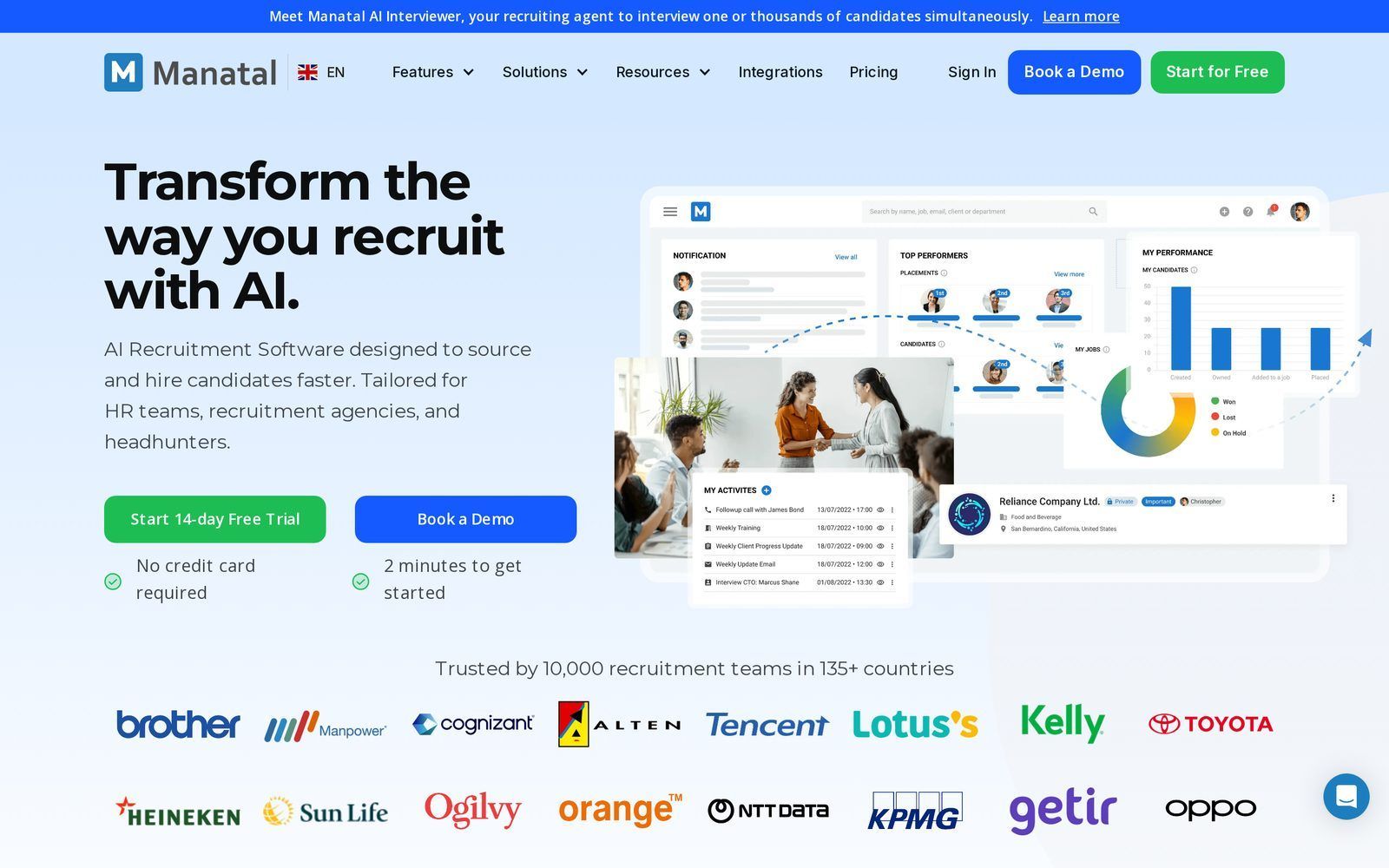
7. Manatal
Where we see it most: recruitment agencies, startups and SMBs that want AI features at the lowest credible price.
Manatal is an AI-first ATS and CRM with a browser extension for LinkedIn sourcing, especially popular with agencies across EMEA and APAC.
- Price: per user a month, billed annually: Professional $15, Enterprise $35, Enterprise Plus $55.
- AI in 2026: candidate scoring and ranking, resume parsing with social enrichment, a People-Match sourcing extension and an AI interview builder.
- What the AI decides, what a person decides: the AI ranks candidates against the job. Whether that job description is right in the first place, and whether the top-ranked person is right for the client, is recruiter judgment.
- Ratings: G2 4.8 (147 reviews), Capterra 4.6 (142 reviews).
- Watch for: basic reporting, weaker Boolean search, and support that can go quiet after onboarding.
- Matchr verdict: the best value on the list.
8. Recruit CRM
Where we see it most: recruitment and executive search agencies that want an ATS and CRM built for agency billing and client management.
Recruit CRM is purpose-built for agencies and earns some of the highest user ratings here.
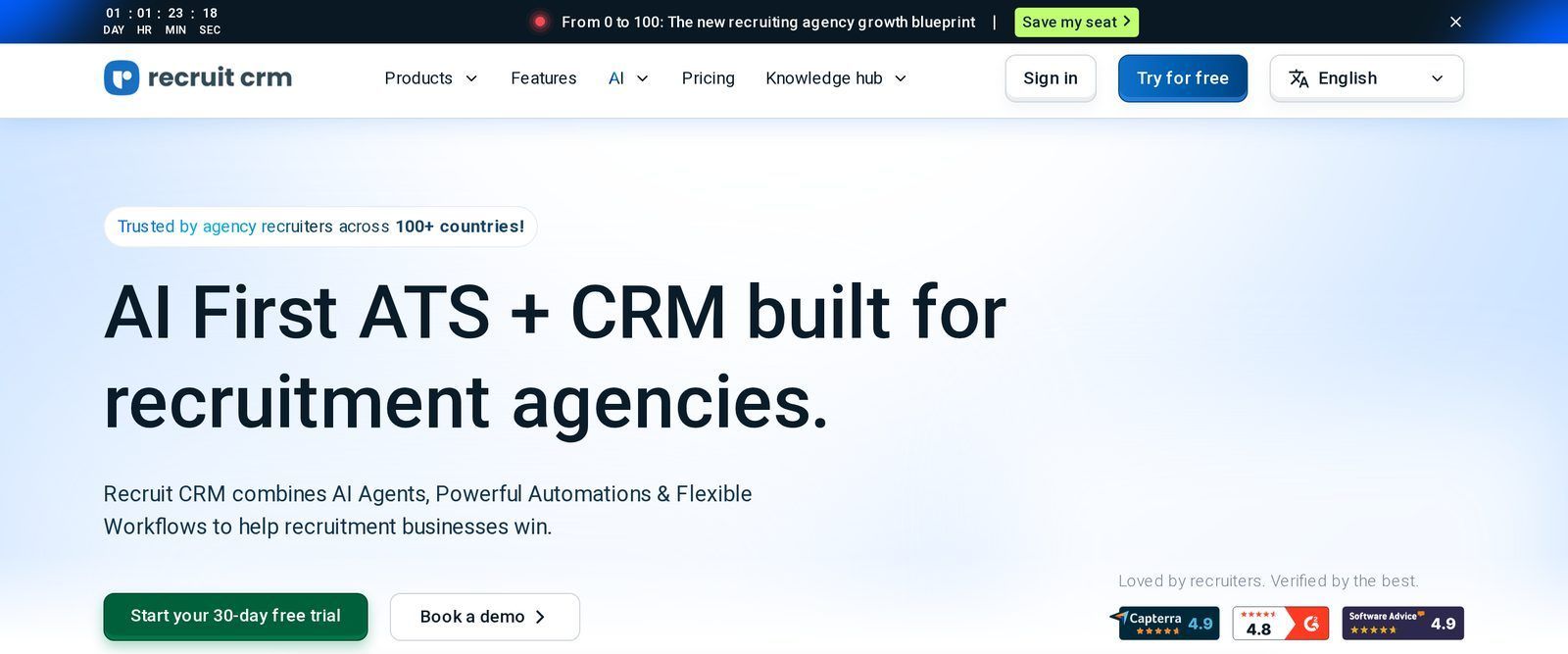
- Price: Pro, Business and Enterprise, billed per user with up to 20% off annually. The pricing page loads figures dynamically, so check the live number before you quote it internally.
- AI in 2026: an AI resume parser, X-ray sourcing, candidate matching, AI agents for parsing, submission and CV formatting, and an MCP connector. AI use is credit-metered even on paid plans.
- What the AI decides, what a person decides: the agents format and submit. Which candidate goes to which client, and the conversation that sells them, is the recruiter's work.
- Ratings: G2 4.8 (125 reviews), Capterra 4.9 (476 reviews).
- Watch for: AI credit costs add up, and reporting is rigid to roll out at scale.
- Matchr verdict: the modern default for search and permanent recruitment firms.
9. Bullhorn
Where we see it most: staffing and recruitment agencies of any size that need ATS, CRM and pay and bill in one system.
If you run a staffing agency, Bullhorn is the system most of your peers already use.
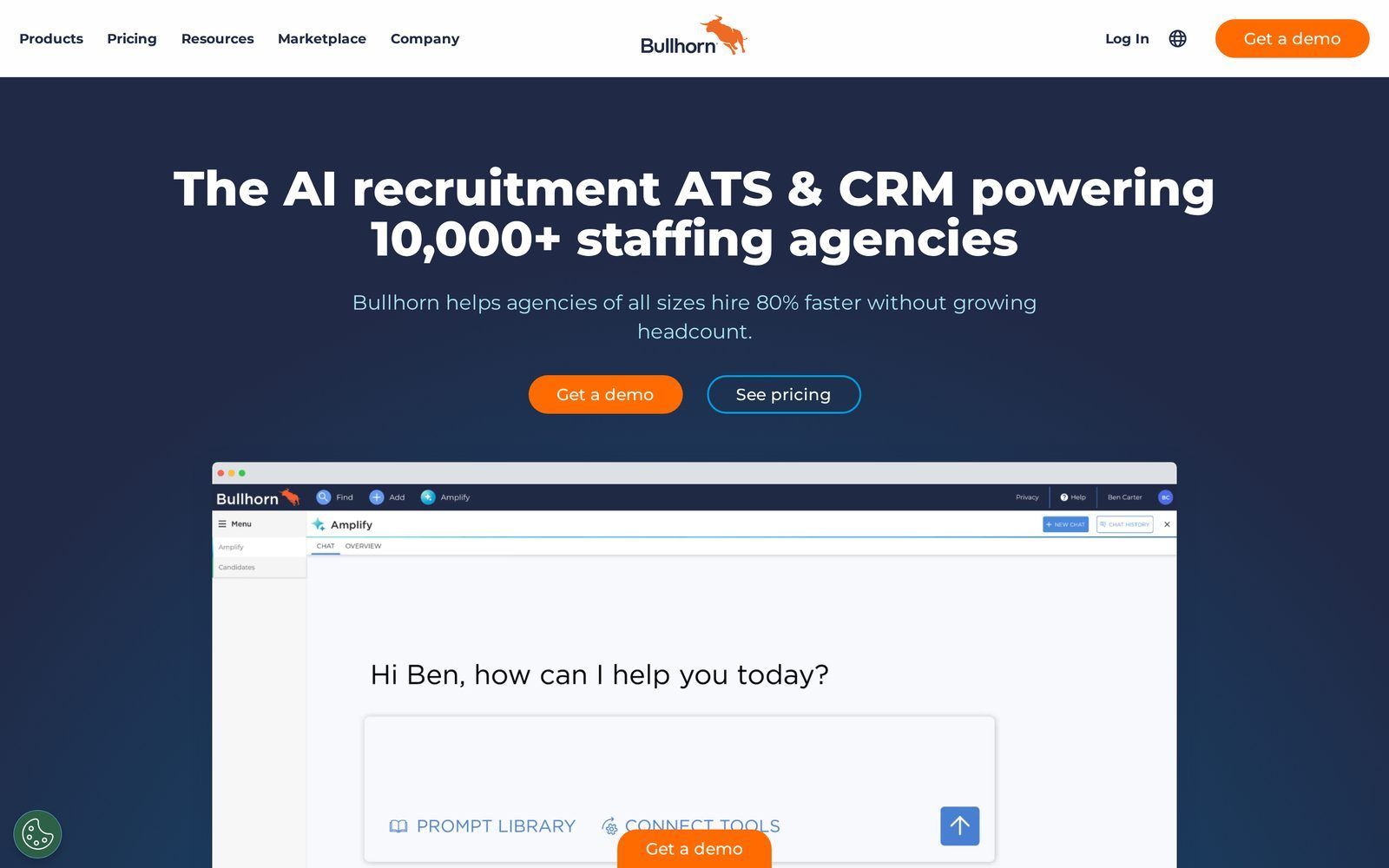
- Price: for small agencies, Starter $99 and Core $165 per user a month. Pro, Max and the enterprise "Bullhorn One" platform are quoted, with implementation on top.
- AI in 2026: Bullhorn Amplify, with digital workers for enrichment, matching, screening and outreach, plus a conversational layer rolling out. AI sits in the Pro tier and up.
- What the AI decides, what a person decides: the digital workers decide who gets contacted and in what order. The client relationship, and the call on whether a contractor is right for a site, stay human.
- Ratings: G2 4.2 (1,176 reviews), Capterra 4.0 (1,023 reviews), the lowest pair in this list.
- Watch for: reviewers report slow performance, a dated interface and high total cost with add-ons. It is overkill for in-house hiring.
- Matchr verdict: still the safest choice for an agency that expects to scale.
10. JazzHR
Where we see it most: small businesses buying their first ATS that want something simple, affordable and flat-rate.
JazzHR keeps things deliberately simple, and its flat annual pricing with unlimited users suits a small team with many hiring managers.
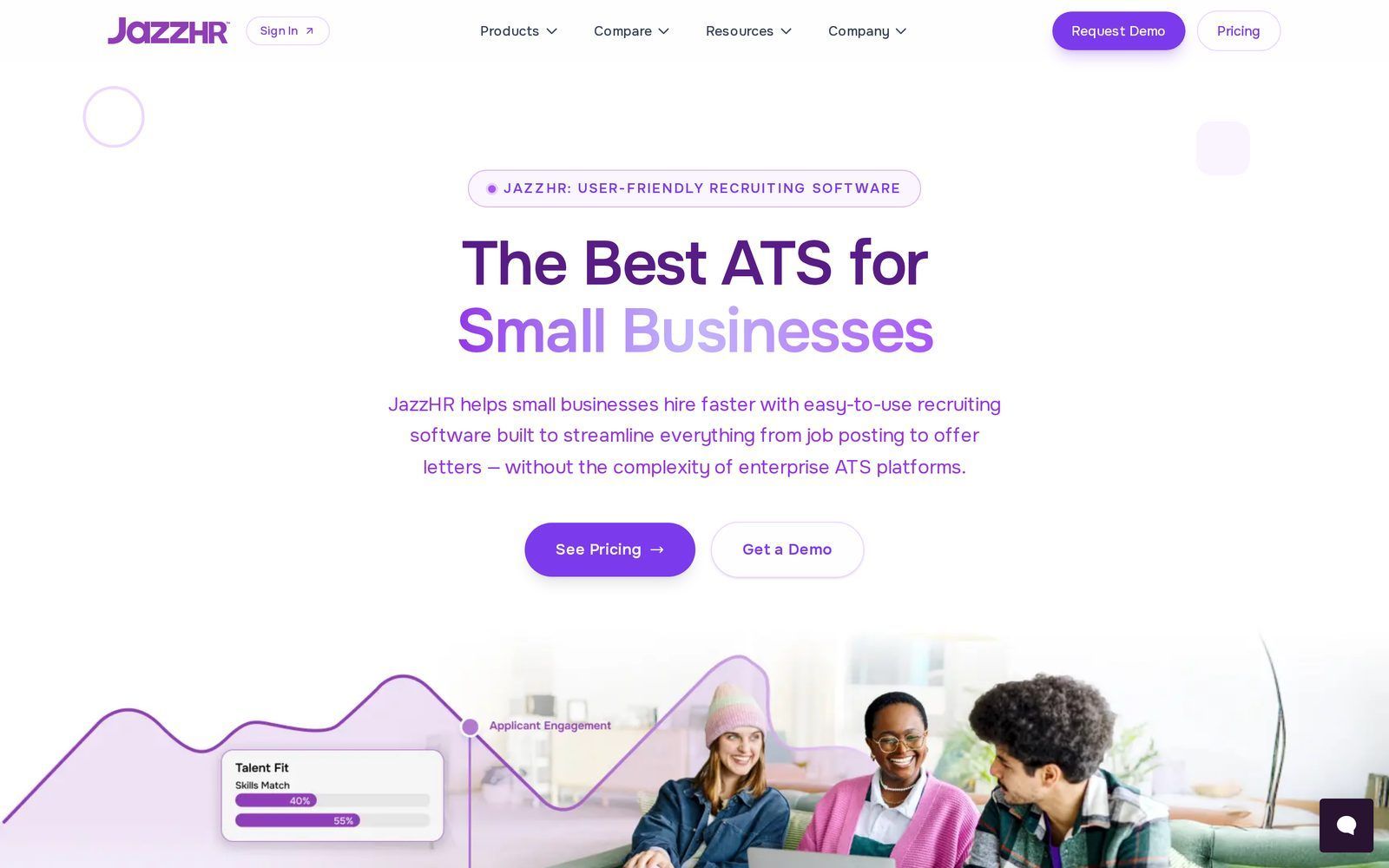
- Price: billed annually with unlimited users: Hero $1,000, Plus $3,480, Pro $5,508 a year. Paying yearly saves up to 24%.
- AI in 2026: candidate matching on Plus and up, which reviewers describe as closer to keyword matching than the AI of newer rivals.
- What the AI decides, what a person decides: very little is automated, which means nearly every decision is a person's. For a first ATS that can be a feature.
- Ratings: G2 4.4 (870 reviews), Capterra 4.3 (495 reviews).
- Ownership: an Employ Inc. brand, alongside Lever and Jobvite.
- Watch for: consumption add-ons and a cancellation process that takes effort.
- Matchr verdict: the simplest honest first ATS.
11. Zoho Recruit
Where we see it most: value-conscious SMBs and small staffing agencies, especially teams already on Zoho.
Zoho Recruit has transparent pricing, a dedicated staffing edition and deep customisation for the price.
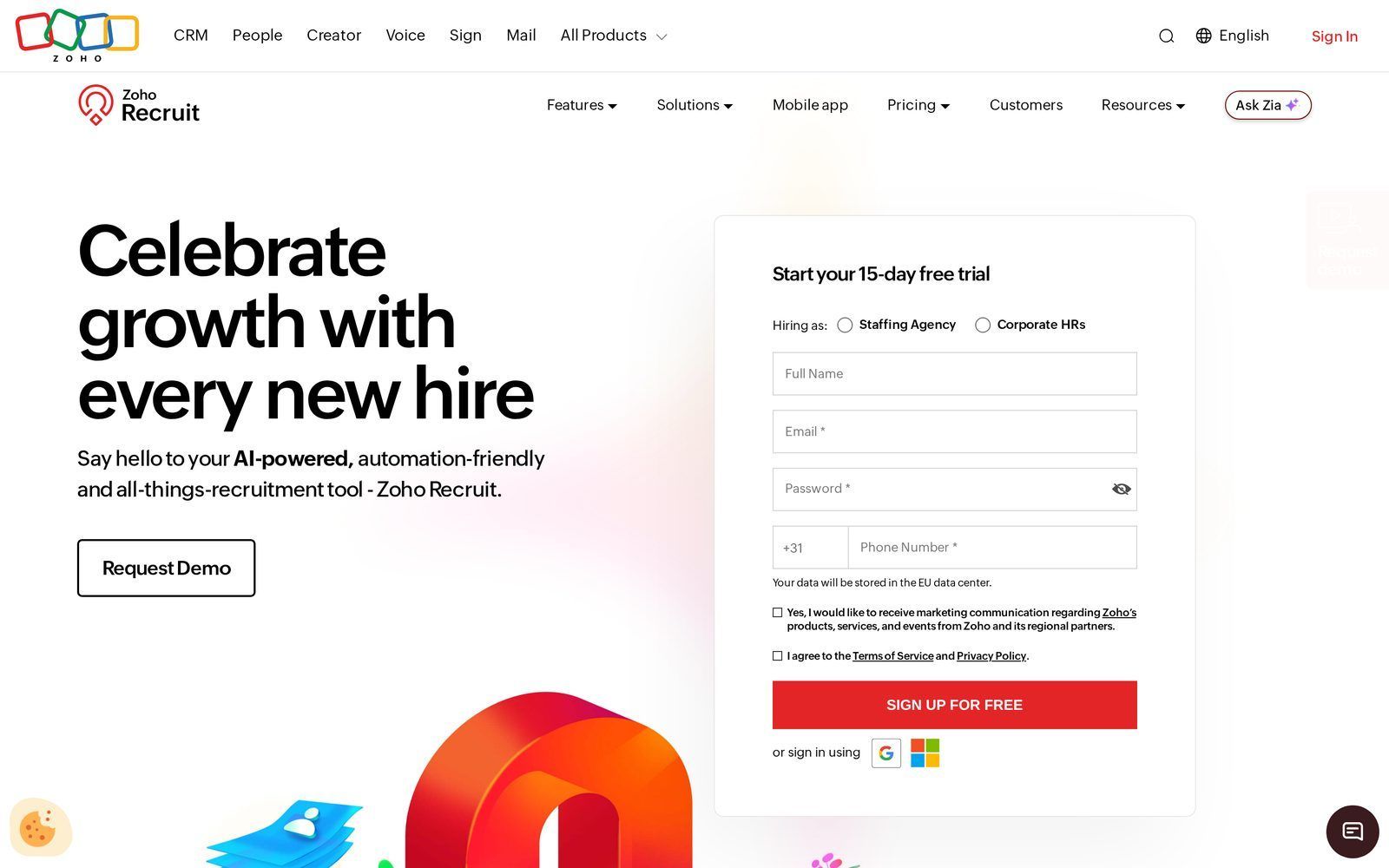
- Price: a free plan with one active job and one recruiter licence. Paid plans start at $25 per recruiter a month billed annually; the staffing edition runs $25, $50 and $75 across Standard, Professional and Enterprise.
- AI in 2026: Zia handles candidate matching with justification, resume parsing, job-description writing and a candidate chatbot. The strongest matching is on Enterprise.
- What the AI decides, what a person decides: Zia proposes matches and explains why. Reading that explanation critically, and overruling it, is the recruiter's job.
- Ratings: G2 4.4 (1,801 reviews), Capterra 4.5 (1,288 reviews).
- Watch for: a dated interface, slow support and automation that takes time to configure.
- Matchr verdict: the most system for the money, if you have someone to configure it.
12. BambooHR
Where we see it most: SMB and mid-market HR teams that want an HR suite with a light ATS built in.
BambooHR is an HR platform first: HRIS, onboarding, payroll and time tracking, with applicant tracking as one module.
- Price: quote only, charged per employee rather than per recruiter, with payroll and other modules extra.
- AI in 2026: "Ask BambooHR" answers HR and policy questions from your data. It is HR-operations AI; the ATS module has little.
- What the AI decides, what a person decides: almost everything in hiring stays manual here.
- Ratings: G2 4.4 (6,013 reviews), Capterra 4.6 (3,612 reviews). Both scores rate the whole HR suite, not the ATS module.
- Watch for: basic recruiting features and an add-on model that inflates the real cost.
- Matchr verdict: right when recruiting is one job among many. Wrong when it is the job.
13. SmartRecruiters
Where we see it most: mid-market to enterprise teams doing collaborative, high-volume hiring, and a natural fit for SAP SuccessFactors customers.
SmartRecruiters is a mature enterprise platform, and its 2026 story is an SAP story: SAP completed the acquisition on 11 September 2025.
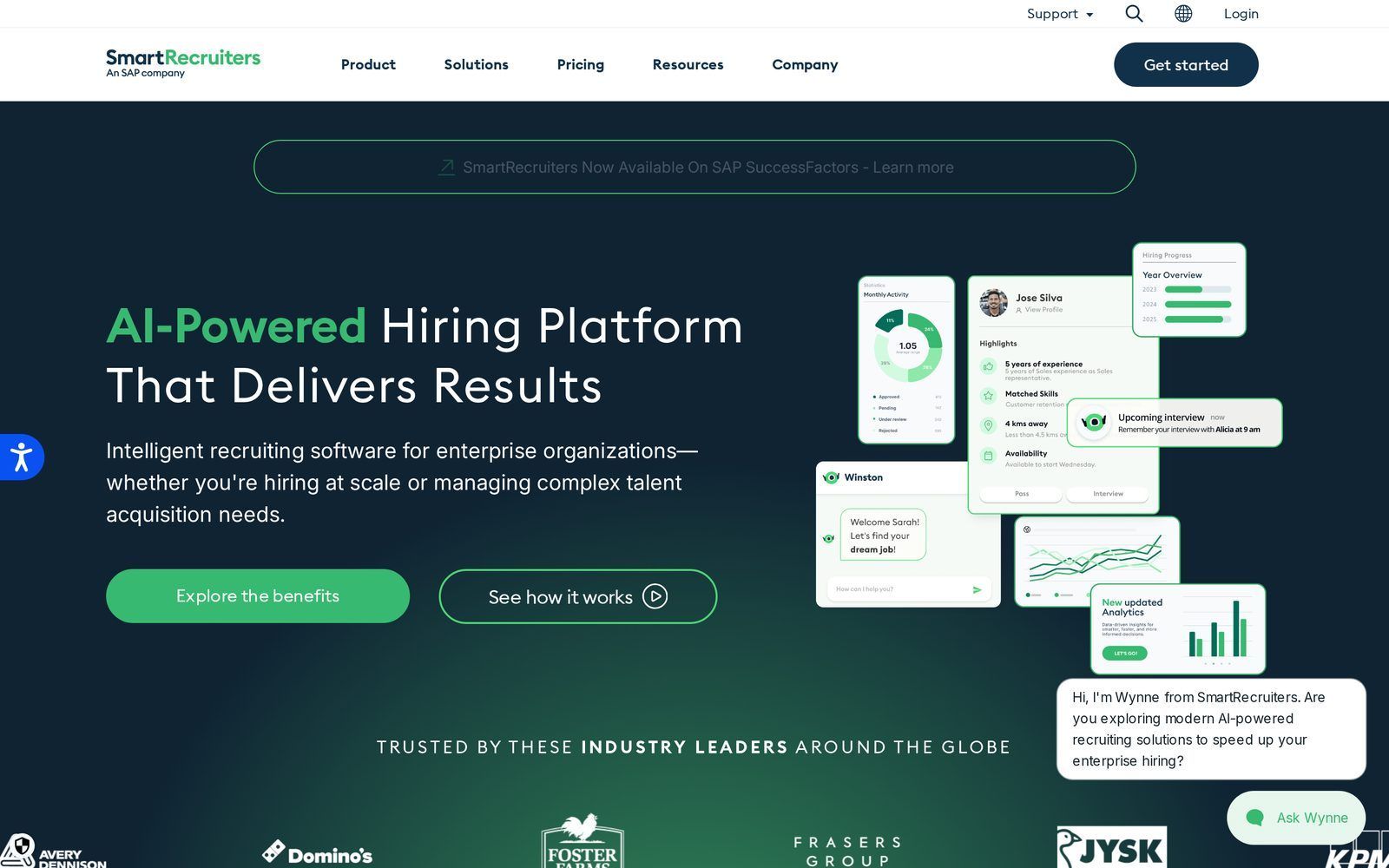
- Price: Essential starts at $14,995 a year; Professional, High Volume and Complete are quote only. No monthly self-serve option.
- AI in 2026: the Winston family (a hiring companion, talent matching and conversational AI), tier-gated.
- What the AI decides, what a person decides: Winston can move high volumes of candidates through early steps. Defining the knock-out criteria it applies, and auditing them, is a human responsibility, and in the EU a regulated one.
- Ratings: G2's SmartRecruiters page showed no score when we checked; Capterra 4.2 (152 reviews).
- Ownership: SAP.
- Watch for: a weak mobile app and slow support, per reviewers, and a roadmap now tied to SuccessFactors.
- Matchr verdict: strong for SAP shops. Everyone else should ask where the roadmap goes next.
14. iCIMS
Where we see it most: large, complex enterprises that need deep configuration, compliance and a full talent-acquisition suite.
iCIMS is built for scale: high-volume, multi-region, heavily governed hiring, with one of the broadest agentic-AI roadmaps on this list.
- Price: quote only, on annual contracts, with implementation on top.
- AI in 2026: iCIMS Copilot, a Digital Assistant and Talent Explorer are live, and its iCIMS Agents (sourcing, conversational applications and analytics) have been rolling out.
- What the AI decides, what a person decides: agents can run a conversational application end to end. Who gets hired, and whether the process is fair across regions, is still decided by people.
- Ratings: G2 4.2 (990 reviews), Capterra 4.3 (824 reviews).
- Watch for: complex reporting, modules and integrations priced separately, and a steep admin learning curve.
- Matchr verdict: the enterprise suite with the deepest bench, for teams with the admin capacity to run it.
15. Recruitee (Tellent Recruitee)
Where we see it most: collaborative SMB and mid-market teams, roughly 50 to 1,000 employees, especially in the EU.
Recruitee is built around collaborative hiring that hiring managers pick up quickly, and it now sits in the Tellent group with HR and performance tools.
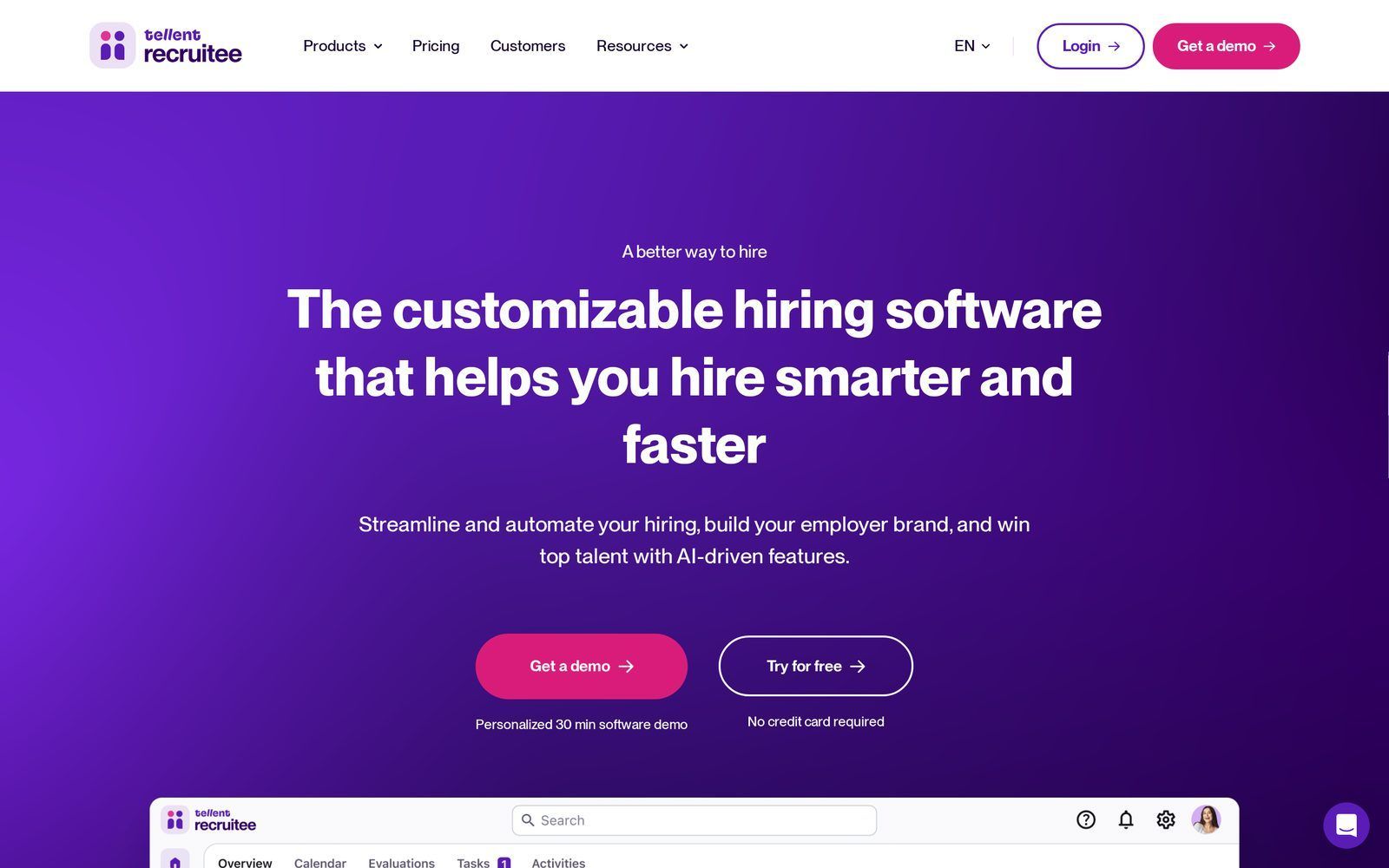
- Price: quote only, based on employee count, with a discount for annual billing.
- AI in 2026: an AI Writer, an AI Screening Assistant that scores applicants and an AI Matching Assistant, all credit-metered and tier-gated.
- What the AI decides, what a person decides: the Screening Assistant scores. The threshold you set, and who looks at the people just below it, is the decision that matters.
- Ratings: G2 4.5 (457 reviews), Capterra 4.4 (194 reviews).
- Ownership: Tellent, backed by PSG Equity.
- Watch for: price increases under the employee-count model and slower, ticket-based support.
- Matchr verdict: the easiest ATS on this list to get hiring managers into.
Honourable mentions
Breezy HR (LTG) has a free-forever plan for one active position and paid plans from $157 a month billed annually; it misses the 15 on AI depth. Jobvite (Employ Inc.) is a capable enterprise system, but at that scale iCIMS and SmartRecruiters give you more. Rippling offers an ATS only as an add-on to its HR and IT platform, so it is worth a look only if you already run Rippling.
Best ATS for staffing and recruitment agencies
An agency ATS has to do something an in-house ATS never does: make money on every placement. That single difference explains most of the shortlist.
In-house systems such as Greenhouse and Ashby are built around one employer's roles. An agency runs dozens of clients at once, submits the same candidate to several of them, tracks fees, and often bills contractors weekly. So the systems below pair applicant tracking with a client CRM, a sales pipeline, submittal workflows and, at the top end, pay and bill.
Bullhorn is where most agencies start looking and where most of the large ones end up. Its small-agency plans are priced publicly at $99 per user per month for Starter and $165 for Core, with the AI-led Pro and Max tiers and the larger "Bullhorn One" front-to-back platform on quote. Bullhorn reports more than 10,000 customers and 1,400 employees across 14 countries. On G2 it holds 4.2 out of 5 across 1,176 reviews, the lowest score in this group, with reviewers pointing at a dated interface and the cost of add-ons. It is still the safest choice for a firm that expects to scale.
Recruit CRM is the modern challenger for search and permanent-placement firms: ATS and CRM in one, a Chrome sourcing extension, an AI resume parser and a newly released MCP connector so the system can be worked through AI assistants. Pricing runs on three plans, Pro, Business and Enterprise, billed per user with up to 20% off on annual billing; the vendor renders the figures dynamically, so confirm the live number before quoting it internally.
Manatal is the value pick. Its Professional plan is $15 per user per month billed annually ($19 monthly), with Enterprise at $35 and Enterprise Plus at $55, and it includes AI candidate scoring and a LinkedIn sourcing extension at every tier. For a five-recruiter agency that is $75 a month, which is why it wins so many first-ATS decisions across EMEA and APAC.
Crelate suits direct-hire and executive search firms that want deeper customisation: Essentials is $85 per user per month billed annually and capped at two users, Business is $119, and the popular Business Plus tier is custom. Zoho Recruit ships a separate staffing-agency edition with a forever-free tier and paid plans at $25, $50 and $75 per recruiter per month billed annually, and JobDiva and Ceipal, both rated 4.7 on G2, lead the enterprise staffing niche.
Our rule of thumb: temp and contract volume points to Bullhorn or JobDiva, permanent and search points to Recruit CRM or Crelate, and a budget under $500 a month points to Manatal or Zoho Recruit. Using an in-house ATS for agency work is the most expensive mistake we see, because you end up rebuilding client management in spreadsheets around it. If sourcing is the bottleneck rather than tracking, start with our list of sourcing tools for recruiters instead.
Best ATS for large companies and enterprise hiring
At enterprise scale the first question is not which ATS is best. It is whether the talent team gets to choose at all.
Jobscan's 2026 data puts Workday behind hiring at more than 40% of the Fortune 500 and SAP SuccessFactors at 12%. In most of those companies recruiting was bought as part of an HR suite, by finance and IT, and the talent team inherited it. If that is you, the useful work is configuration, not selection: interview kits, scorecards, reporting and the add-ons your suite allows.
When the talent team does choose, three systems lead the shortlists we see:
- Greenhouse for structured, consistent hiring across many teams, with the integration depth to sit next to an HR suite. Quote only.
- iCIMS for high-volume, multi-region hiring with heavy compliance needs and the admin team to configure it. Quote only.
- SmartRecruiters for collaborative high-volume hiring, and the obvious pick if you already run SuccessFactors, since SAP now owns it. Essential starts at $14,995 a year.
Budget for more than the licence. Enterprise implementation is quoted separately, and none of these vendors publishes a figure for it, so ask for the all-in first-year cost in writing. Ask, too, how many administrator hours the system needs each week once it is live; that number decides whether the configuration you paid for survives the first reorganisation.
Best ATS with AI in 2026: what has actually shipped
Almost every ATS now says AI. Fewer have shipped it, and a growing share charge for it separately. This table separates what is live from what is priced as extra.
| System | Shipped and live | Paid extra or metered |
|---|---|---|
| Ashby | Interview notetaker, AI in analytics, candidate matching | Notetaker is a paid add-on |
| Greenhouse | Real Talent matching, sourcing automation, fraud checks | Fraud and identity checks on higher tiers |
| Workable | AI Recruiting Agent that sources, screens and chats | Credits: 5,000 for $600 |
| Lever | Screening and matching signals, interview summaries | Agentic careers-site screening add-on |
| Teamtailor | Co-pilot for summaries, job ads and reports | Included in quoted plans |
| Pinpoint | Candidate Companion chatbot, CV screening help | Included in quoted plans |
| Manatal | Scoring and ranking, parsing, sourcing extension | Included at every tier |
| Recruit CRM | Parser, X-ray sourcing, matching, agents | Credit-metered on paid plans |
| Bullhorn | Amplify digital workers | Pro tier and up |
| Zoho Recruit | Zia matching with justification, parsing | Strongest matching on Enterprise |
| SmartRecruiters | Winston companion and matching | Tier-gated |
| iCIMS | Copilot, Digital Assistant, agents rolling out | Quoted modules |
| Recruitee | Writer, Screening and Matching assistants | Credit-metered |
Two rules for reading any AI claim. First, ask what the AI decides without a person in the loop: surfacing, scoring and summarising are one thing, rejecting is another, and in the EU the difference is regulated. Second, ask what it costs at your volume. Metered credits look cheap in a demo and expensive on a role with hundreds of applicants. For the wider numbers, see our AI in recruiting statistics.
ATS ratings: what G2 and Capterra users say
Captured on G2 and Capterra in September 2026, sorted by G2 score. Review counts matter as much as the score: a 4.8 from 125 reviewers is a different signal from a 4.4 from 6,000.
| System | G2 score | G2 reviews | Capterra score | Capterra reviews |
|---|---|---|---|---|
| Manatal | 4.8 | 147 | 4.6 | 142 |
| Recruit CRM | 4.8 | 125 | 4.9 | 476 |
| Ashby | 4.7 | 190 | 4.4 | 15 |
| Teamtailor | 4.6 | 563 | 4.6 | 112 |
| Pinpoint | 4.6 | 165 | 4.7 | 91 |
| Recruitee | 4.5 | 457 | 4.4 | 194 |
| Greenhouse | 4.4 | 3,956 | 4.5 | 765 |
| Workable | 4.4 | 688 | 4.4 | 662 |
| JazzHR | 4.4 | 870 | 4.3 | 495 |
| Zoho Recruit | 4.4 | 1,801 | 4.5 | 1,288 |
| BambooHR (whole HR suite) | 4.4 | 6,013 | 4.6 | 3,612 |
| Lever | 4.3 | 2,124 | 4.6 | 654 |
| Bullhorn | 4.2 | 1,176 | 4.0 | 1,023 |
| iCIMS | 4.2 | 990 | 4.3 | 824 |
| SmartRecruiters | Not shown | Not shown | 4.2 | 152 |
Sources: G2's ATS category and the product review pages linked in each review above; Capterra product pages, linked the same way. The spread is narrow: G2's category average is 4.46 across 606 products, so the top and bottom of this table are less than a point apart. The agency tools score highest because their users are small teams with one clear job. The enterprise suites score lowest because they are configured by one team and used by thousands. Neither fact tells you how the system will work for you.
How to choose an ATS (and why the tool is not the hard part)
The shortlist narrows fast once you answer five questions honestly.
- How big is your team, and how fast is it growing? Under 50 employees points to JazzHR, Zoho Recruit or Breezy HR. Scaling tech teams point to Ashby or Workable. Thousands of employees point to Greenhouse, iCIMS or SmartRecruiters, if the HR suite has not decided for you.
- In-house team or agency? In-house teams want structured hiring and candidate experience (Greenhouse, Ashby, Pinpoint, Teamtailor). Agencies want client management, submittals and billing (Bullhorn, Recruit CRM, Manatal). Using the wrong kind is the most expensive mistake we see.
- What should the AI decide? If AI screening will change your team's daily work, weight the systems that have shipped it, then write down which decisions stay with a person. Be sceptical of "AI" that turns out to be keyword matching.
- What is the real budget? Price the licence, the metered AI, the add-ons and the implementation for your first year, not the sticker.
- What must it connect to, and where does the data live? Your HRIS, calendar and assessment tools, plus the GDPR questions above if you hire in Europe.
Then comes the part no comparison can do for you. An ATS organises hiring. It does not do it. We see this in client teams every quarter: a company switches systems hoping the software will fix a process problem, and six months later the new system shows the same bottleneck, with better dashboards. No ATS will run an intake nobody books, or interview a candidate no hiring manager makes time for.
As a global embedded RPO partner, we at Matchr work inside whatever system our clients run, and the pattern is consistent: the tool decides how smoothly the work flows, and structure, judgment and a hiring team that shows up decide whether the work happens at all. The AI in these systems decides more every year. What it cannot decide is what good looks like for your role, and who should make the final call. If your hiring is under-resourced rather than under-tooled, compare in-house vs agency vs RPO vs embedded RPO before you compare software, or read how an embedded recruitment partner works inside your ATS. And if you want to talk it through against your actual plan, let's get in touch.
Frequently asked questions
What is the best applicant tracking system in 2026?
There is no single best ATS. It depends on team size, whether you hire in-house or run an agency, budget and how much you rely on AI. Scale-ups most often shortlist Ashby and Workable; enterprises Greenhouse, iCIMS and SmartRecruiters; agencies Bullhorn, Recruit CRM and Manatal; small businesses JazzHR, Zoho Recruit or Breezy HR.
Which ATS do most companies use?
Among the largest US employers, Workday: Jobscan finds it at more than 40% of the Fortune 500. Across a broader set of 13,130 companies, Greenhouse leads at 19.0%, followed by Workday, Lever and iCIMS.
How much does an ATS cost in 2026?
From free (Zoho Recruit and Breezy HR each have a one-job free plan) to $15 per user a month (Manatal), $1,000 a year flat (JazzHR), $299 a month for a small company on Workable, and $14,995 a year for SmartRecruiters' entry enterprise plan, before implementation. Ask for the all-in first-year cost.
Which ATS is best for small business?
JazzHR for flat-rate simplicity with unlimited users, Zoho Recruit for value and customisation, and Breezy HR if a free plan is the deciding factor. BambooHR fits if you want HR and hiring in one system.
Which ATS is best for recruitment agencies?
Bullhorn at scale, with ATS, CRM and pay and bill in one; Recruit CRM for growing recruitment and search firms; Manatal for cost-conscious agencies. In-house systems such as Greenhouse and Ashby are a poor fit for agency billing.
Which ATS has the best AI in 2026?
The systems shipping the most capable AI, rather than announcing it, are Ashby, Workable with its recruiting agent, Manatal, iCIMS with its agents, and Bullhorn with Amplify. Check which AI features are metered, and which decisions they make without a person.
How do I choose an ATS?
Answer five questions: team size and growth, in-house or agency, what the AI should decide, the real first-year budget, and what the system must connect to (plus GDPR if you hire in Europe). Then shortlist two or three and run a real role through each.
Are Lever, JazzHR and Jobvite the same company?
Yes. All three are Employ Inc. brands. They are sold as separate products but share a parent, which matters if you shortlist more than one.
What is the difference between an ATS and a recruitment CRM?
An ATS manages people who have applied to open roles. A recruitment CRM manages relationships with people you may hire later, before a role exists. Many systems, such as Ashby, Lever and Recruit CRM, combine both.
Is my ATS GDPR compliant?
The system can support compliance; your configuration and contracts deliver it. Check automatic deletion, logged consent for talent pools, candidate data requests, hosting location and the data processing agreement.
Do I need an ATS if I use an embedded RPO or recruitment partner?
Usually yes, and a good partner works inside your ATS rather than replacing it. Our embedded recruiters work in whatever system you run, so your process, data and candidate history stay with your team. The ATS is where the work lives; the partner is who does it.


