
Recruitment
Tech Layoff Trackers 2026: Layoffs.fyi and 6 Alternatives
The seven best tech layoff trackers in 2026, compared, with how to use them for sourcing.

Senior Tech Talent Sourcer · Matchr
![7 Best (Tech) Layoff Trackers [The Ultimate Comparison]](https://cdn.sanity.io/images/0ve0r4az/production/a083d3de8ba2fdd291d09c84a0a3974bbf5cc9db-1920x1080.png?w=1600&q=80&fit=max&auto=format)
Layoffs.fyi is still the best tech layoff tracker to start with in 2026: the broadest coverage, the most widely cited, free, and updated continuously. It is not the only one worth using. TrueUp, WARNTracker, TechCrunch, Crunchbase, Peerlist and GamingLayoffs.com each add something it lacks, from official US filings to sector charts, and all seven are free to browse. The market they track has not settled. After the 2022 peak, open tech roles fell sharply through 2023 and recovered only modestly, and in 2026 layoffs are running at or above 2025 levels, with AI restructuring named as a driver in many of this year's cuts. Some of the biggest 2026 reductions so far include Oracle (around 21,000 roles over twelve months), Amazon (16,000 in January, after 14,000 the previous autumn), Intel and Microsoft.
A tech layoff tracker is a free, regularly updated database of company layoffs that shows which companies cut roles, how many people were affected, and where. For talent and HR teams, it is a simple way to read a fast-moving market: to see where experienced people are newly looking, time your outreach, and reach them with care for what they are going through.
This guide compares the seven best tech layoff trackers in 2026, what each one tracks, how current it is, its strengths and limits, and which fits your needs, whether you hire in the US or globally, in tech broadly or a niche like gaming. A few more worth bookmarking are in the "More trackers" section at the end.
Comparison at a glance
| Tracker | What it tracks | Coverage | Free? |
|---|---|---|---|
| Layoffs.fyi | Tech layoffs, company-level plus some employee lists | Global, tech | Free |
| TechCrunch tracker | Major tech layoffs, with context | Global, tech | Free |
| WARNTracker | All-industry layoffs from official WARN filings | US only | Free (paid bulk export) |
| Crunchbase | Notable US tech layoffs plus weekly writeups | US tech | Free |
| TrueUp | Tech layoffs, open jobs, and sector breakdowns | Global, tech | Free |
| Peerlist | Tech layoffs, clean lightweight view | Global, tech | Free |
| GamingLayoffs.com | Video-game layoffs and studio closures | Global, gaming | Free |
At a glance: which tracker to use
- Most comprehensive overall: Layoffs.fyi
- Most authoritative context on the biggest cuts: TechCrunch
- Most reliable data (US): WARNTracker, built on official filings
- Best visualisations and sector view: TrueUp
- Best weekly context and writeups: Crunchbase
- Best lightweight complement: Peerlist
- Best for gaming hires: GamingLayoffs.com
Layoffs.fyi
Records: continuously updated since 2020 (check the live count on the page) · Pricing: Free
Layoffs.fyi is a free project by internet entrepreneur Roger Lee that has tracked tech layoffs since the start of COVID-19. It is the most well-known and widely cited layoff tracker. It includes tabs for tech companies with layoffs and layoff charts.
Companies with layoffs
The core feature is a searchable table of companies that have conducted layoffs.
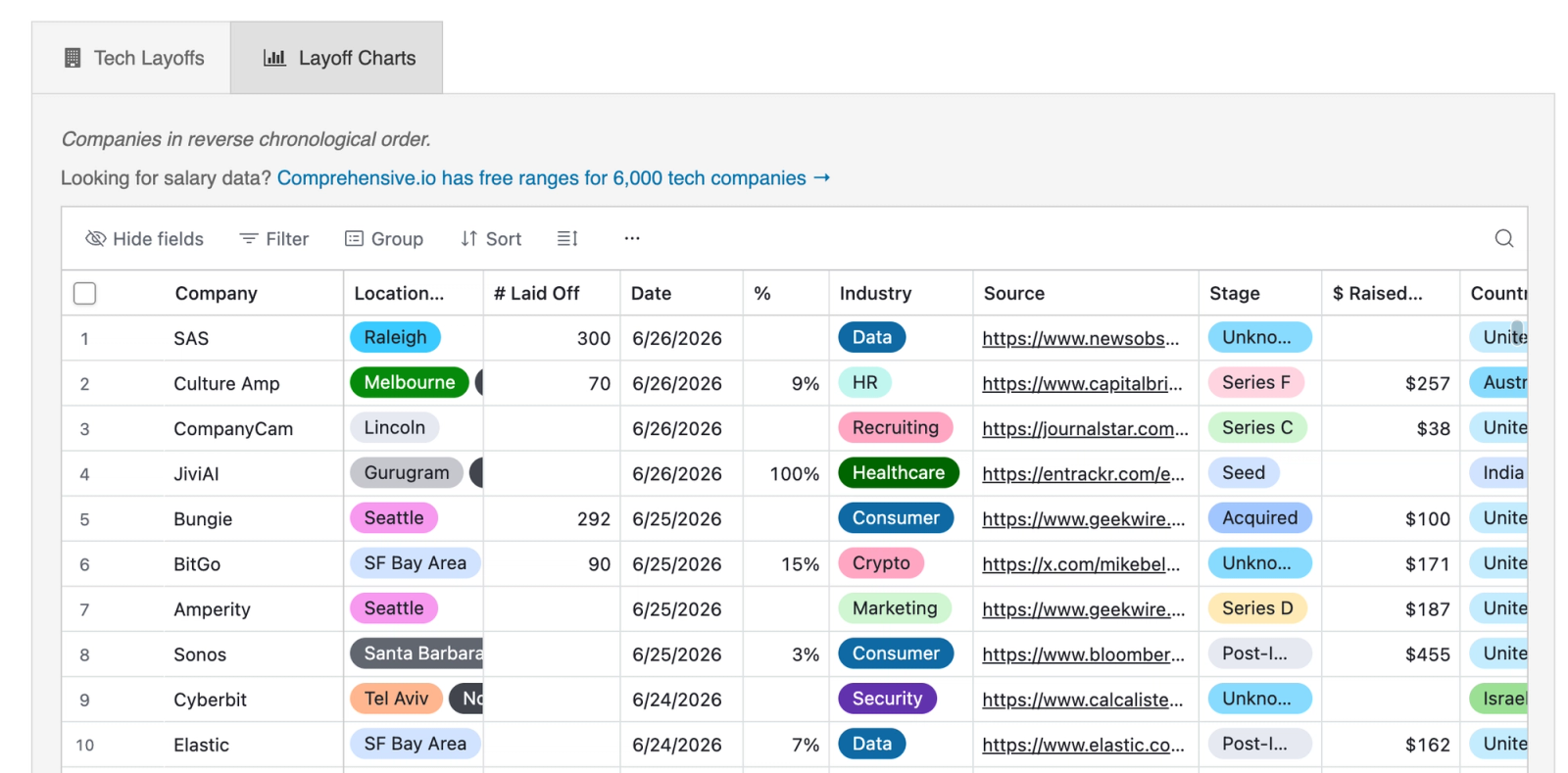
Each entry includes Location HQ, number laid off, date, percentage of the workforce affected, industry, company stage (for example Series E or Post-IPO), funds raised, country, and the date the record was added. The table is powered by Airtable, so you can sort, filter, and hide fields.
Layoff charts
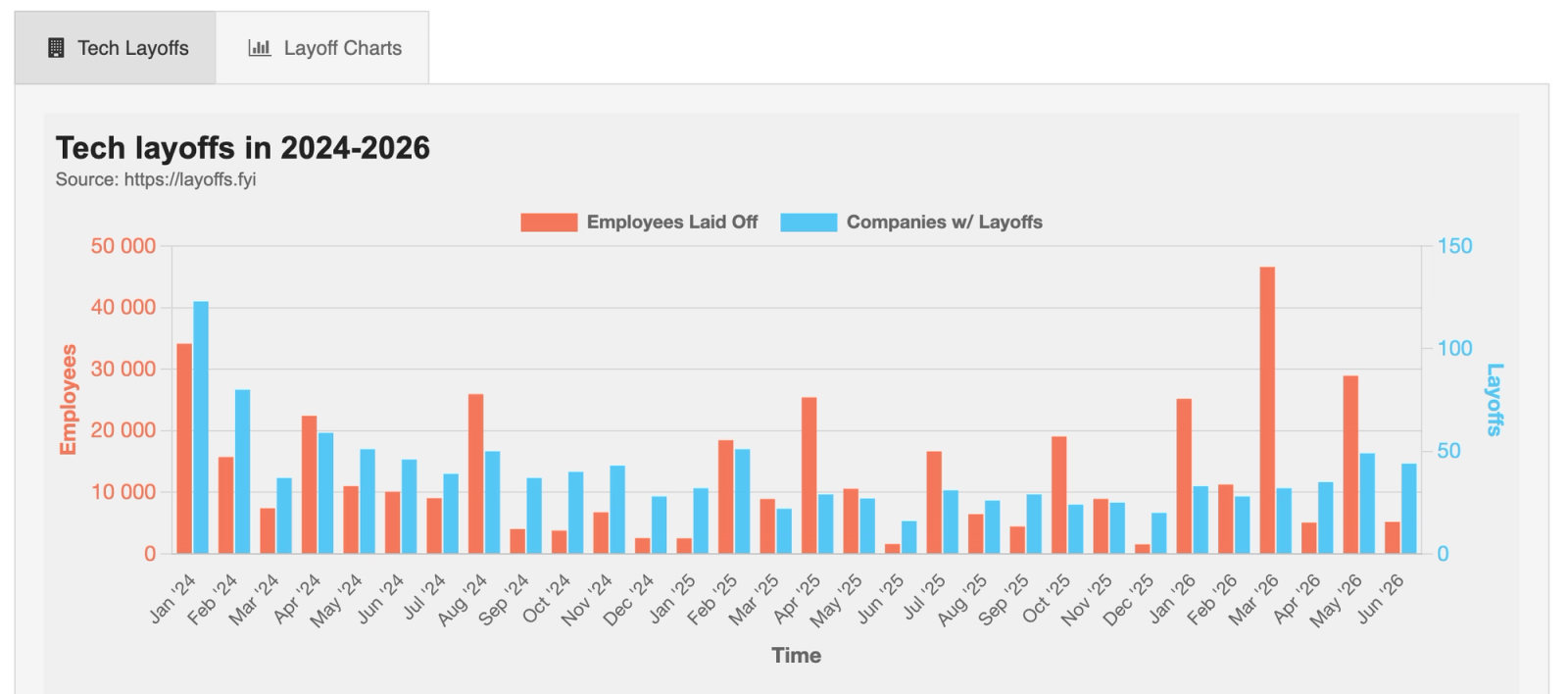
The Layoff Charts tab has interactive charts, including tech layoffs by quarter, tech layoffs since COVID-19, and US federal DOGE layoffs.
Is Layoffs.fyi worth using?
Yes. It has one of the largest company databases and clear visuals, is widely cited, free, and needs no registration. It is the best starting point for a broad, global view of tech layoffs.
TechCrunch Layoffs Tracker
Records: major tech layoffs, updated continuously · Pricing: Free
TechCrunch maintains a running, reverse-chronological list of major tech layoffs, updated continuously through 2026 and explicitly flagging where employers cite AI as a factor. Each entry is a short, sourced writeup of the company, the scale of the cuts, and the context.
Because it is editorial rather than a database, it skews toward larger, newsworthy layoffs (Oracle, Amazon, Microsoft, Intel, Meta) instead of complete coverage, but the context and reliability are excellent.
Is the TechCrunch tracker worth using?
Yes, as a context layer. It will not give you a filterable database, but it is the most authoritative quick read on the biggest cuts and the reasons behind them. Pair it with Layoffs.fyi for breadth.
WARNTracker
Records: around 8 million employees across 40,362 companies (1988 to 2026), updated daily · Pricing: Free to browse, paid bulk export
WARNTracker, built by software engineers Steven Zhang and Chris Talley, is based on official WARN Act notices that US employers must file before large layoffs. A WARN notice is a 60-day advance notice that employers with 100 or more employees must give before a plant closure or mass layoff affecting 50 or more people, so some layoff dates in the tracker are in the future. Data covers most US states.
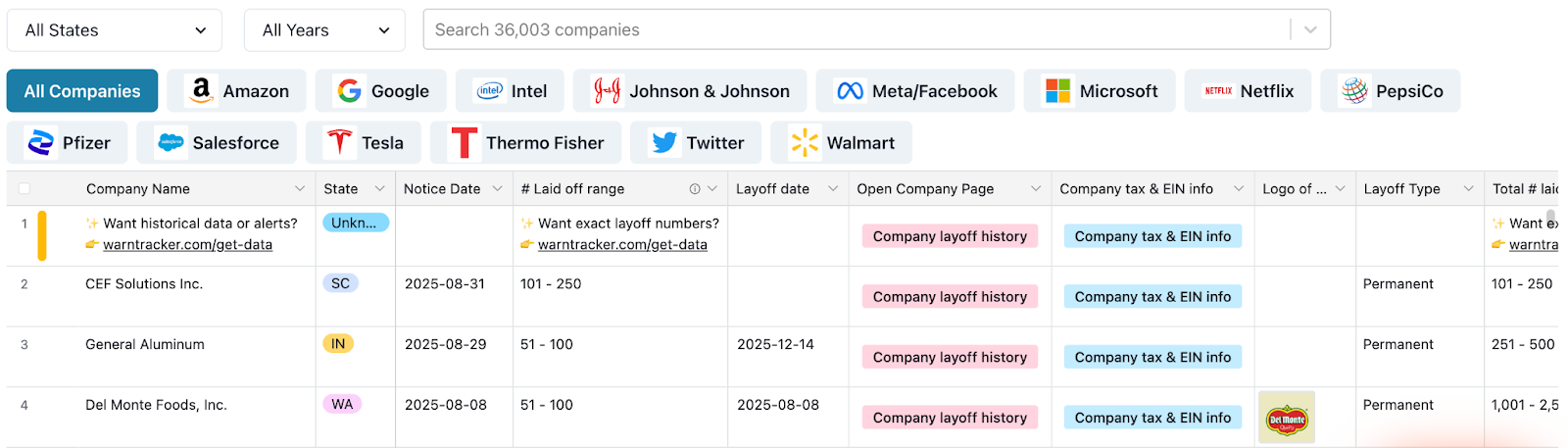
You can browse free by state, year, and company. A one-time full dataset export and a weekly subscription to new WARN data are paid, and you can request profiles of laid-off employees (also paid). WARNTracker stands apart in a few ways:
- It monitors layoffs across all sectors, not only tech.
- The data comes from individual government filings, so it is more reliable than open-source or crowdsourced data.
- It is granular, showing specific offices affected and exact employee counts.
- Notices may appear before or after a public announcement, giving an early signal.
Is WARNTracker worth using?
Yes, if you hire in the US. It is the most reliable and granular source here. The caveats: not every state requires full WARN disclosure, so it is not exhaustive, and it is US-only.
The Crunchbase Tech Layoffs Tracker
Records: notable US tech layoffs, updated continuously · Pricing: Free
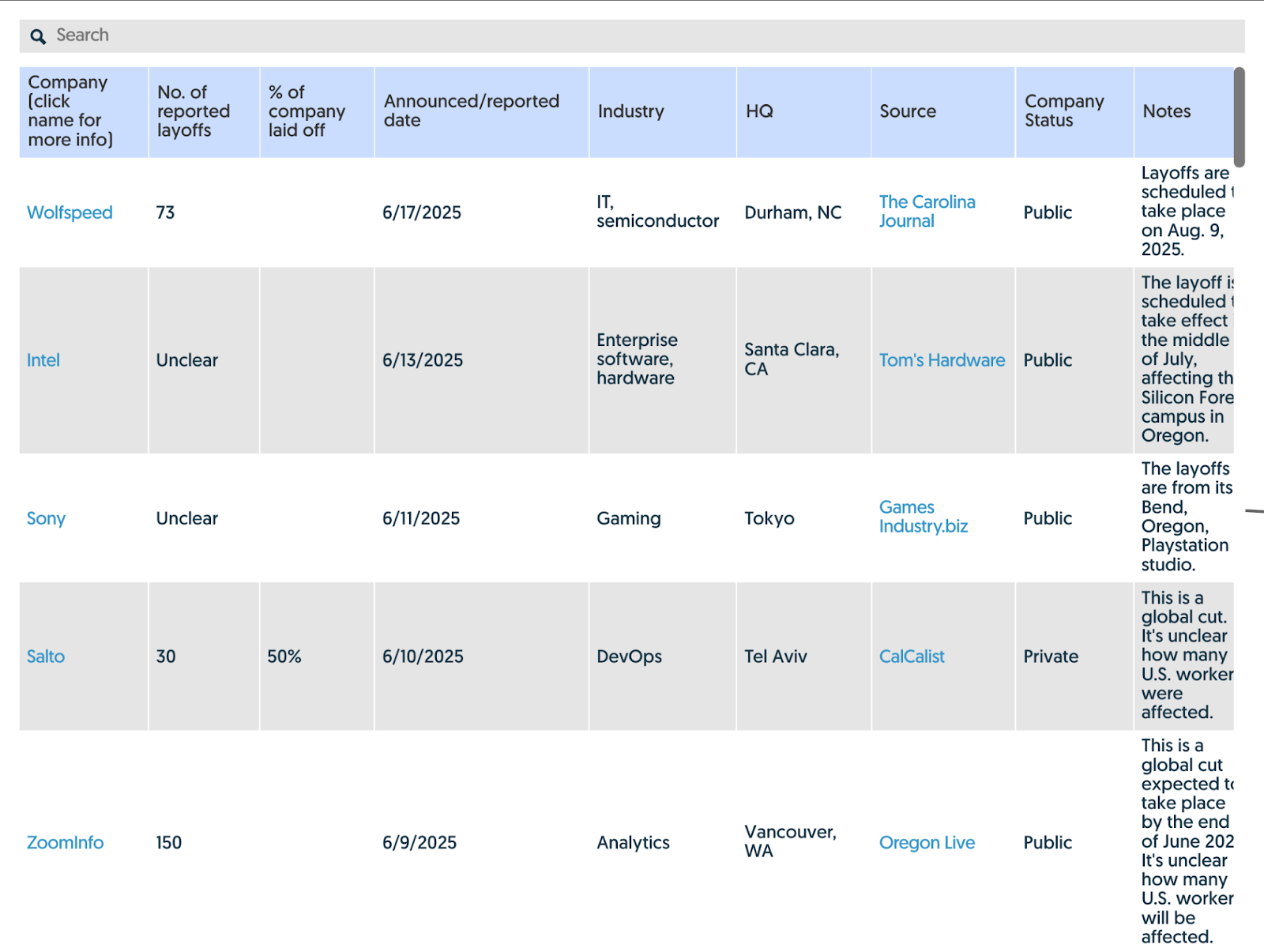
The Crunchbase Tech Layoffs Tracker lists notable US tech layoffs, drawing on media reports, Crunchbase's own reporting, social posts, and Layoffs.fyi. It covers US-based companies or those with a strong US presence, and pairs the data with regular writeups. By Crunchbase's count, about 127,000 US tech workers were cut in 2025.
Is the Crunchbase tracker worth using?
Good if you hire for US startups and like context alongside the data. It is easy to use and to copy into a spreadsheet, and, contrary to some older roundups, it is still actively maintained in 2026. The database is smaller than Layoffs.fyi.
TrueUp Tech Layoff Tracker
Records: 2026 year-to-date around 157,000 people across roughly 415 layoffs; 2025 around 246,000 · Pricing: Free
TrueUp shows layoffs, open job counts, tech-stock moves, and more across big tech, unicorns, and startups. On the number of tech employees let go tab, an interactive chart shows people impacted and the companies with the most layoffs.
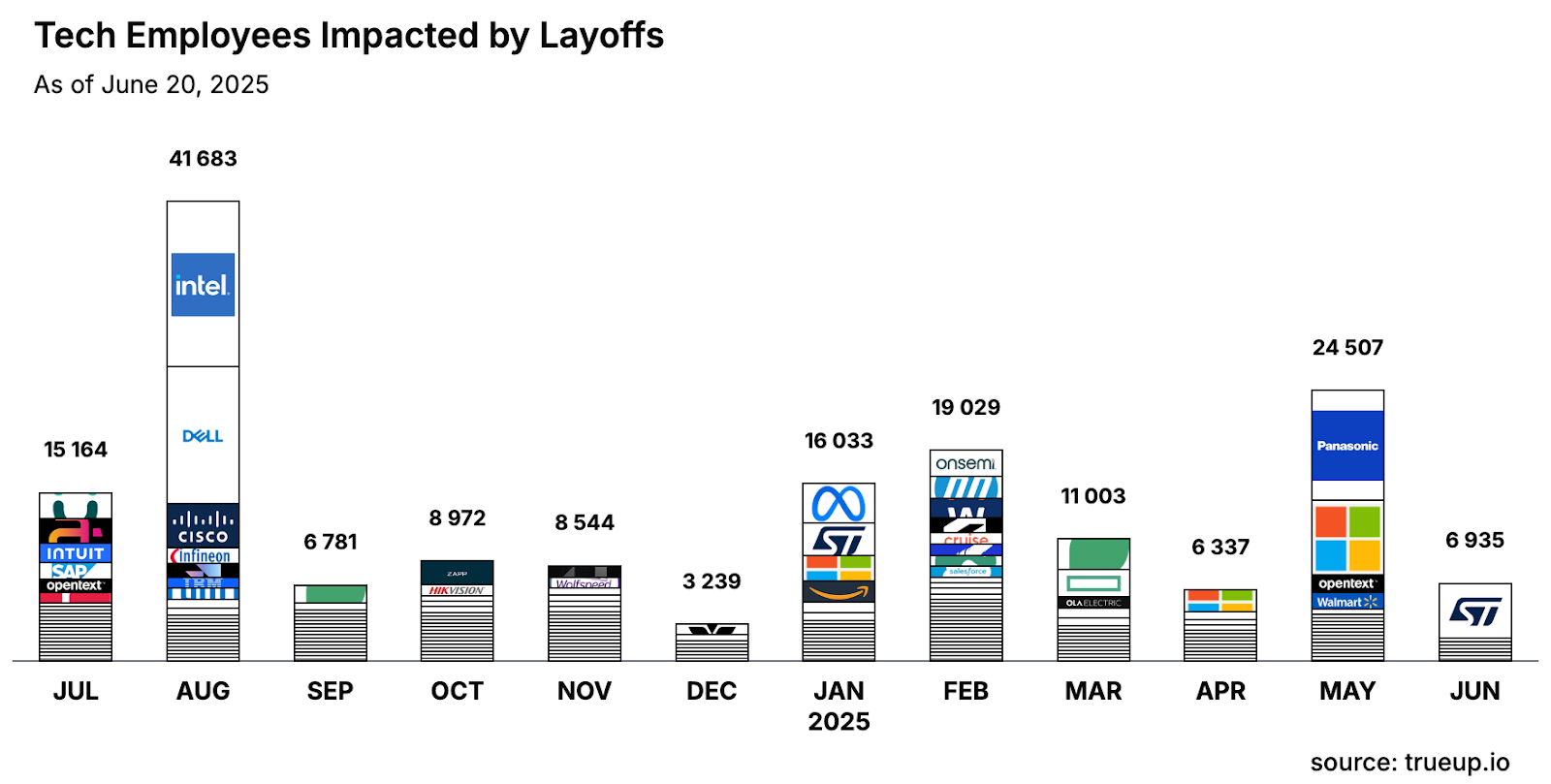
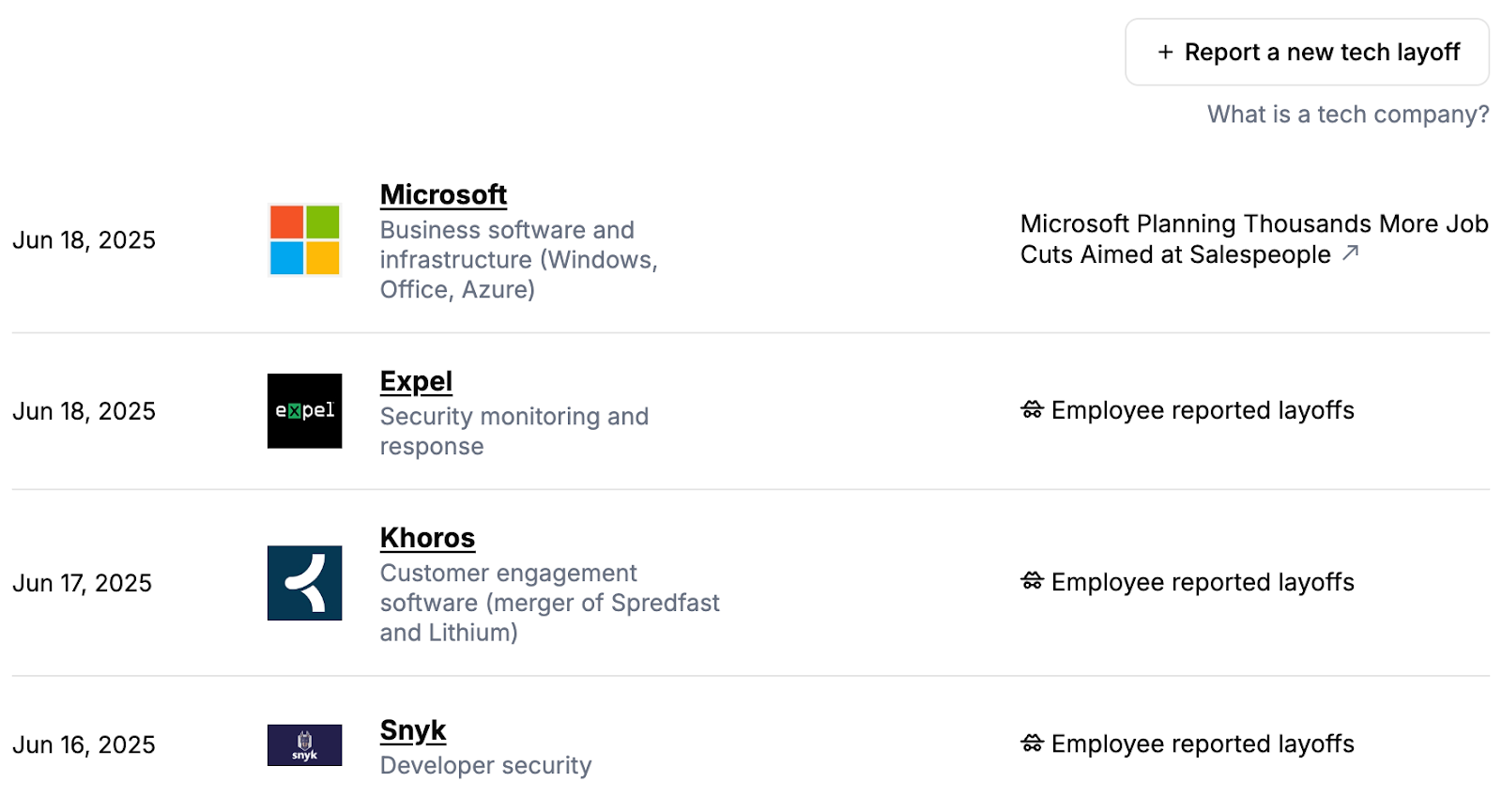
There is also a company-level table of layoff data.
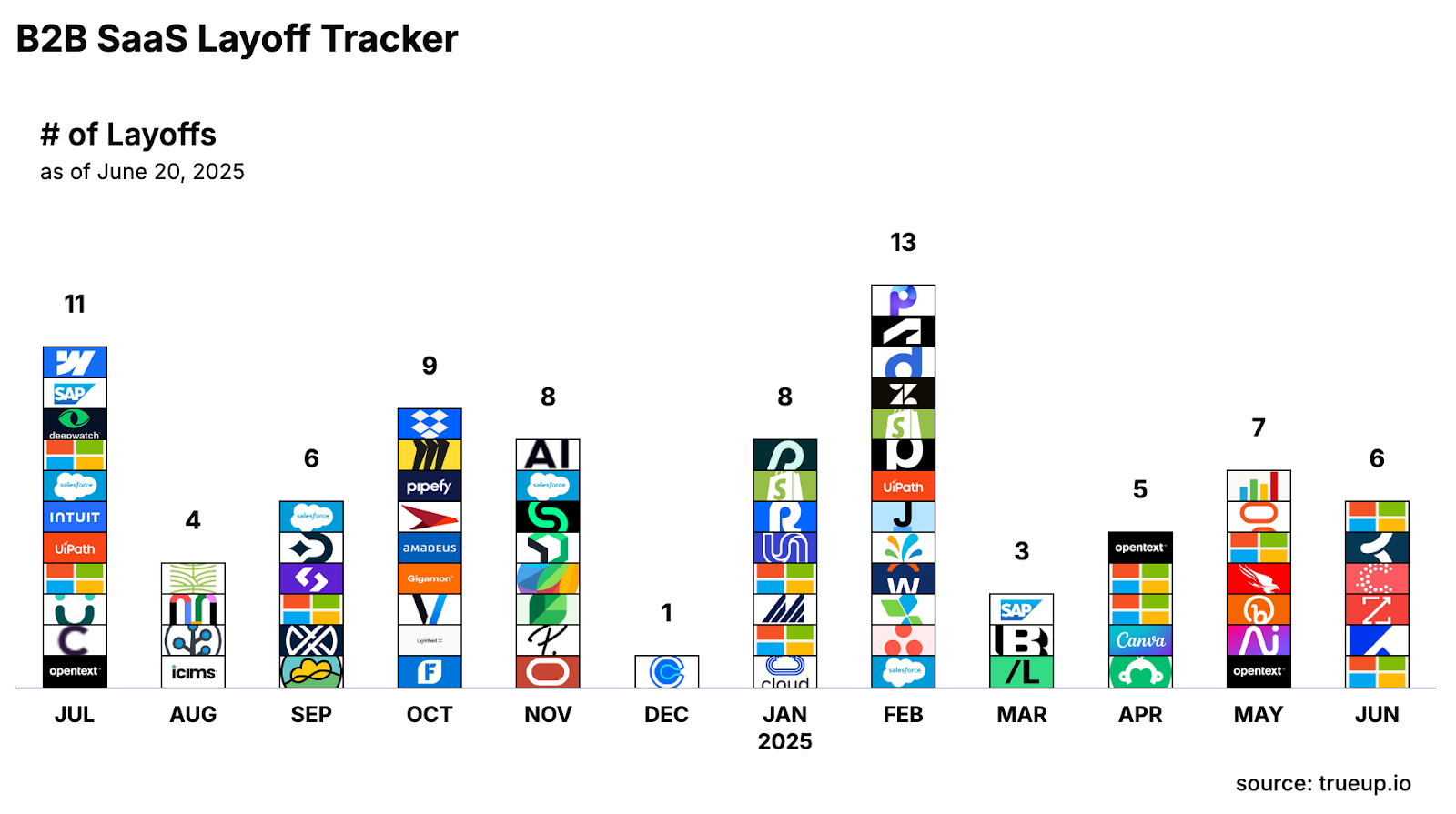
A standout feature is the breakdown of layoffs by sector, such as FinTech, Health, eCommerce, and EdTech.
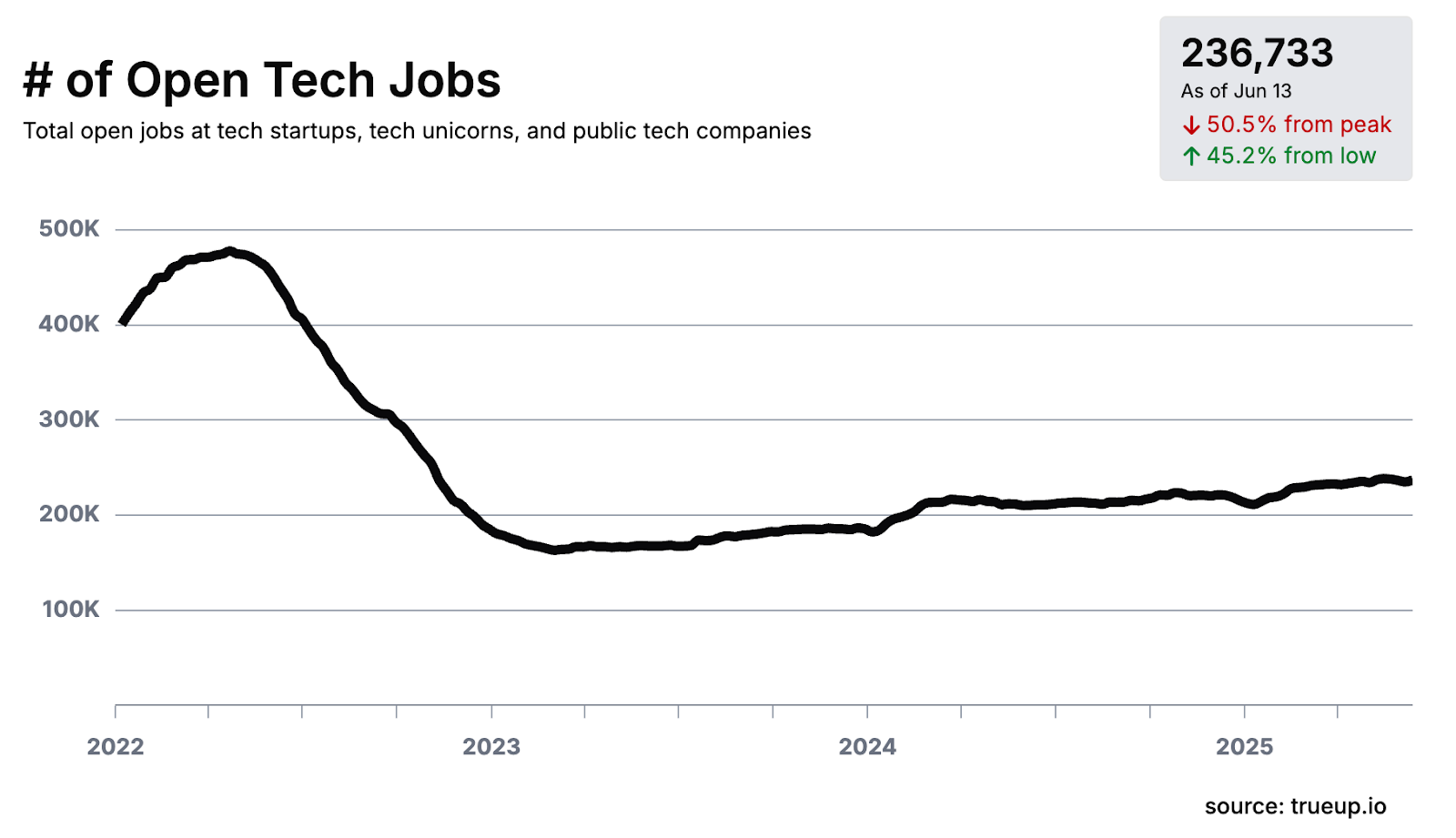
The number of open tech jobs tab charts the state of hiring in the industry.
Is TrueUp worth using?
Yes, for its visualisations and the variety of its data. It gives a fast snapshot of tech hiring and layoff dynamics. It is lighter on detailed filters and does not list individual laid-off employees.
Peerlist
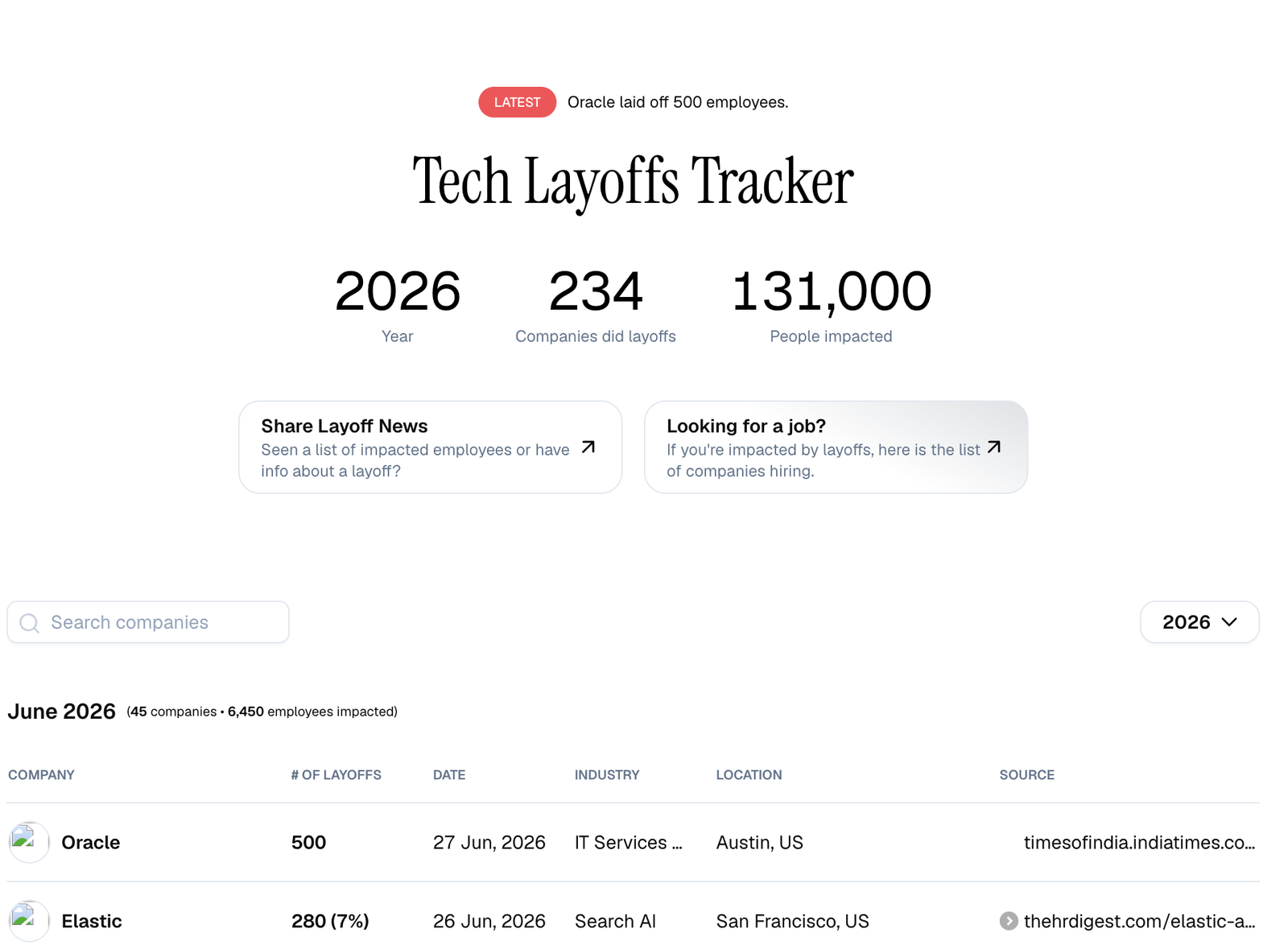
Records: 2026 around 226 companies and 130,000 employees (check live) · Pricing: Free
Peerlist's Layoffs Tracker is a free, clean tool that logs layoffs by company, date, industry, location, and number of employees affected, with historical context showing broader trends over time.
Is Peerlist worth using?
Yes, as a lightweight complement. The database is smaller, but it is well-maintained and sometimes captures companies the bigger trackers miss.
GamingLayoffs.com
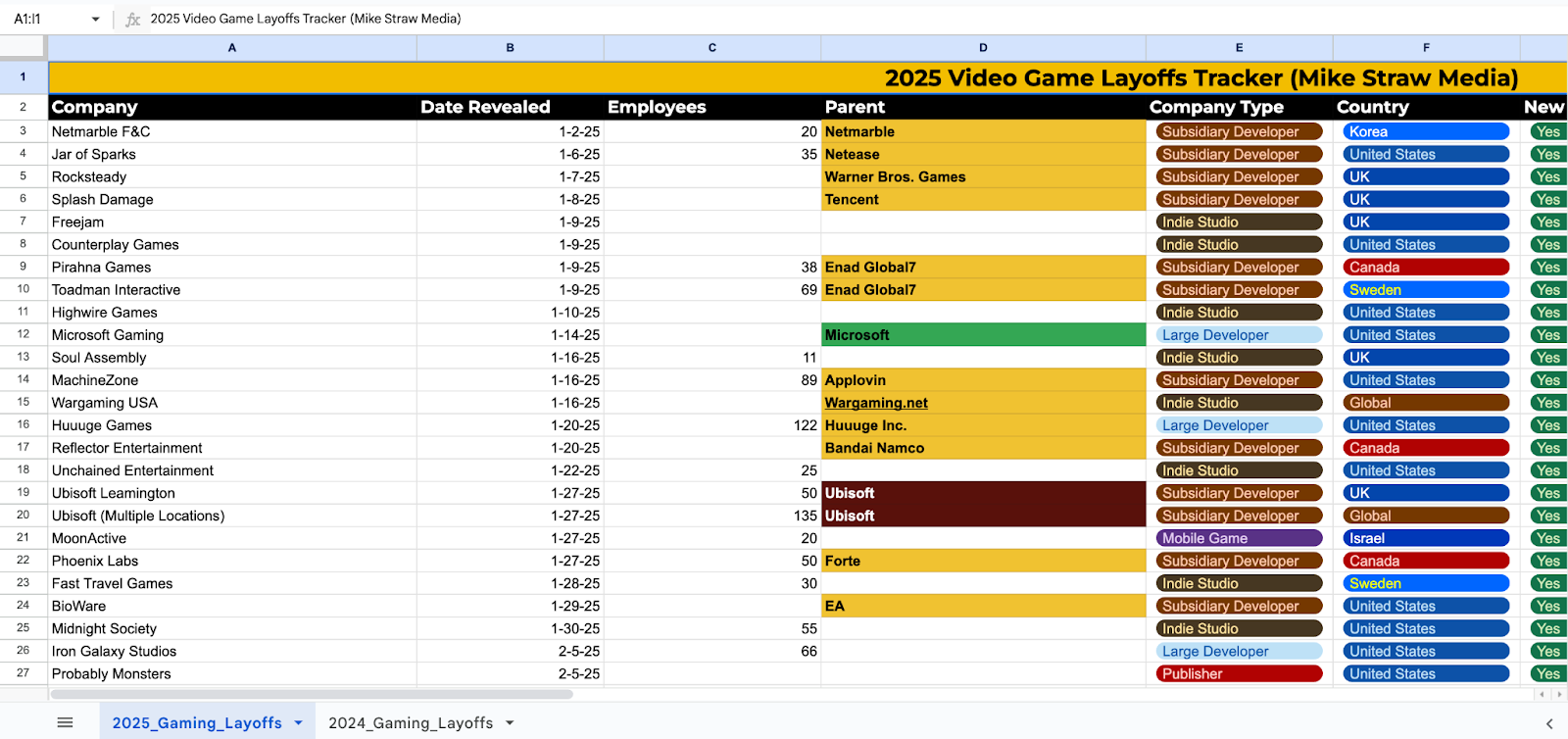
Records: 2026 around 4,530 layoffs across 79 companies and 16 studio closures (the all-time peak was 2024, around 14,900) · Pricing: Free
GamingLayoffs.com, from Mike Straw Media, focuses entirely on the video-game industry. It logs layoffs and studio closures by company, date, number of employees affected, parent company, and country, from a public, regularly updated source, and links out to games-industry job boards and support resources.
Is GamingLayoffs.com worth using?
Yes, if you hire in or watch the gaming sector. It is specialised and reliable, and it surfaces niche or regional studios that the general trackers miss.
More trackers worth knowing
Beyond the seven above, two more are worth bookmarking:
- SkillSyncer Layoffs Tracker: a free, regularly updated 2026 tracker (around 267 events year-to-date) aggregated from company announcements, SEC filings, and news, with a clean, tech-focused view.
- thelayoff.com: not a database but an employee-discussion forum where firsthand accounts and rumours surface, sometimes ahead of official confirmation. Treat it as unverified signal rather than data.
How to use a layoff tracker for sourcing
A tracker only matters if it changes what you do next. Layoffs are hard on the people they affect, so the aim is not to race to a list. It is to find experienced people who are newly open, at the right moment, and to approach them with care for where they are.
Here is a simple way to turn tracker data into a thoughtful sourcing motion:
- Watch the roles and regions you actually hire for. Filter by industry, location, and company stage so you see the cuts that match your openings, not the whole feed.
- Move quickly, but not first. A well-researched note in the same week lands better than a generic message fired off within the hour.
- Confirm before you act. Cross-reference a layoff against a second tracker or the company's own announcement, since early reports can be wrong or overstated.
- Lead with the person, not the vacancy. Acknowledge the situation briefly, focus on their experience, and make it easy to say no. A warm, low-pressure message builds a relationship that outlasts a single role.
- Build a talent pool, not a one-off list. Tag people you cannot place today and come back when the right role opens. Today's contact is often next quarter's hire.
The right sourcing stack makes this easier. See our guides to 24 Chrome extensions for sourcing and recruitment and the 100 best AI tools for recruiters.
As a global embedded RPO partner, we at Matchr see the same pattern across markets: the teams that hire well in a downturn are not the fastest to a list. They are the ones with the structure to act on a signal and the care to act on it well.
A tracker tells you who is open. How you make contact decides whether they ever want to work with you.
Frequently asked questions
What is the best tech layoff tracker in 2026? Layoffs.fyi is the most comprehensive and widely cited. For official US data use WARNTracker, for the biggest cuts and context use TechCrunch, for visualisations use TrueUp, and for gaming use GamingLayoffs.com.
Are tech layoff trackers free? Most are completely free, including Layoffs.fyi, TechCrunch, Crunchbase, TrueUp, Peerlist, and GamingLayoffs.com. WARNTracker is free to browse but charges for bulk data export.
How accurate are layoff trackers? Crowdsourced trackers such as Layoffs.fyi are fast and broad but rely on media and self-reporting. WARNTracker uses official government filings, so it is more reliable for the US but misses smaller and non-US layoffs. Cross-reference two sources for important decisions.
How often are they updated? The major trackers update daily to weekly. Always check the last-updated date on the page before quoting a figure.
Which layoff tracker should you choose?
There is no single best layoff tracker; the right one depends on where and how you hire. For the broadest, most-cited view of global tech layoffs, start with Layoffs.fyi. If you hire in the US and want the most reliable, granular data, WARNTracker draws on official government filings. TrueUp is the best for visualisations and sector breakdowns, TechCrunch and Crunchbase for context and writeups, and Peerlist as a clean, lightweight alternative that sometimes catches what others miss. For gaming, GamingLayoffs.com is the focused choice. Most teams end up using two together: one broad tracker for coverage and one official source to confirm the details.
Whatever you choose, treat the data as a starting point, verify the last-updated date, and approach affected talent with respect. Need help turning a volatile market into a stronger team? Let's get in touch.