
Recruitment
20 Best Diversity Recruiting Tools and Platforms in 2026
The 20 best diversity recruiting tools and platforms for 2026, with current pricing, real user reviews, and what each is best for, from inclusive job ads to bias-reduced screening.
The Global Embedded RPO Company

Diversity recruiting tools are software platforms that help employers attract, source, screen, interview, and measure candidates in ways that widen the talent pool and reduce bias. They span inclusive job-description writers, diversity sourcing engines, blind and skills-based assessments, fair-chance background checks, and DEI analytics. The right ones make your hiring process fairer and your shortlists stronger, without slowing anything down.
The market looks different in 2026 than it did even two years ago. The category has consolidated, with several standalone tools absorbed into larger talent suites. AI and skills-based assessment have moved to the center, replacing resume-led screening with structured, job-related evaluation. And compliance has tightened: New York City's Local Law 144 now requires bias audits for automated hiring tools, the EU AI Act adds obligations for high-risk hiring systems, and pay-transparency rules are expanding across Europe even as some US employers scale back formal DEI programs.
The result is a clearer divide between tools that simply post to job boards and tools that genuinely reduce bias and prove it. Here are the 20 best diversity recruiting tools and platforms for 2026, grouped by what they help you do, with current pricing and a balanced view of what real users say.
Inclusive job description tools
Most bias enters before the first application, in the wording of the job post. These tools fix the top of the funnel.
Textio
Textio pioneered augmented writing that flags biased or exclusionary language as you write, and in 2026 it spans both recruiting copy and interview and performance feedback.
Key features
- Real-time inclusive-language guidance as you write
- Bias flagging across job posts and interview or performance feedback
- Phrasing analysis tied to who is likely to apply
- Purpose-built, audited HR language AI
Pricing: Custom (quote-based) · Rating: G2 4.2 out of 5
What users loved: the live bias flagging genuinely improves inclusivity. "It flags language that can be steered more toward certain groups or dissuade others so that I can be more inclusive." (Marketing reviewer, G2)
What they flagged: cost is steep for low-volume teams. "The cost of the product is too high for the amount of job descriptions that we actually use it for." (Non-Profit reviewer, G2)
Best for: teams that want one inclusive-language standard across hiring and feedback.
Datapeople
Datapeople gives recruiters live guidance inside a smart editor and tracks diversity metrics across the funnel through your ATS.
Key features
- Real-time inclusive-language suggestions in a smart editor
- Flags for gendered, exclusionary, or unclear phrasing
- Job-post clarity and readability scoring
- Full-funnel diversity analytics via ATS integration
Pricing: Custom (quote-based) · Rating: G2 4.4 out of 5
What users loved: it makes inclusive, clear postings almost automatic. "It makes it borderline impossible to not have the most inclusive, concise, and all-around impactful job posting." (Anabel D., G2)
What they flagged: the scoring can feel too strict. "The most common suggestion is that our job postings are too long. However, that is largely due to our diversity statement and including compensation information." (Computer Software reviewer, G2)
Best for: data-minded TA teams that want language guidance plus funnel analytics.
Ongig
Ongig's Text Analyzer uses natural-language processing to catch biased wording and standardize inclusive job descriptions at scale.
Key features
- NLP detection of gendered and exclusionary language
- Inclusive-language rewrite suggestions
- Job-title and readability scoring
- Built for standardizing many descriptions at once
Pricing: From $4,900/year (Lite); Professional from $14,900/year · Rating: Limited public reviews
What stands out: strong inclusive-job-description functionality built for scale.
What to consider: there is no rated G2, Capterra, or TrustRadius profile yet, and pricing is premium for smaller teams, so trial it and treat vendor testimonials as marketing rather than peer reviews.
Best for: higher-volume employers standardizing many job descriptions.
Diversity sourcing and talent intelligence tools
These widen the top of the funnel and let you see representation before you reach out.
SeekOut
SeekOut is consistently rated among the strongest diversity-sourcing platforms, combining mature DEI filters with analytics across more than a billion profiles.
Key features
- Advanced DEI search filters across more than a billion profiles
- Representation goal-setting and diversity funnel analytics
- Deep technical and Boolean profiling (GitHub, patents, publications)
- OFCCP and EEOC-oriented reporting
Pricing: Custom (quote-based) · Rating: G2 4.5 out of 5 (750+ reviews)
What users loved: precise, filter-rich search. "When I add different filters, it's very accurate and definitely helps to narrow down the type of profile I'm looking for." (Anna C., Technical Sourcer, Capterra)
What they flagged: contact-data freshness and a dated interface. "It seems to me that the platform is outdated." (Brittany P., Manager, Capterra)
Best for: teams that want best-in-class diverse sourcing with the data to prove it.
LinkedIn Talent Insights
LinkedIn Talent Insights turns LinkedIn data into workforce and talent-pool insights, including gender-diversity benchmarking against your industry and competitors. For a faster signal on which teams just came back onto the market, pair it with a tech layoff tracker.
Key features
- Gender-diversity benchmarking vs industry and competitor averages
- Talent supply and demand mapping by location
- Workforce movement and migration trends
- Compensation and skills insights
Pricing: Custom (quote-based) · Rating: G2 4.5 / Capterra 4.6
What users loved: real-time market and diversity data in one place. "It helps analyze talent availability across specific regions, understand gender diversity trends, view workforce movement, and access compensation insights." (Anjaly T., Market Research Consultant, G2)
What they flagged: data can feel broad or delayed for niche roles. "Some of the data can feel too broad or delayed, especially for niche or fast-changing technical roles." (Aayush S., Technical Recruiter, G2)
Best for: strategic workforce and diversity planning before you source.
Eightfold AI
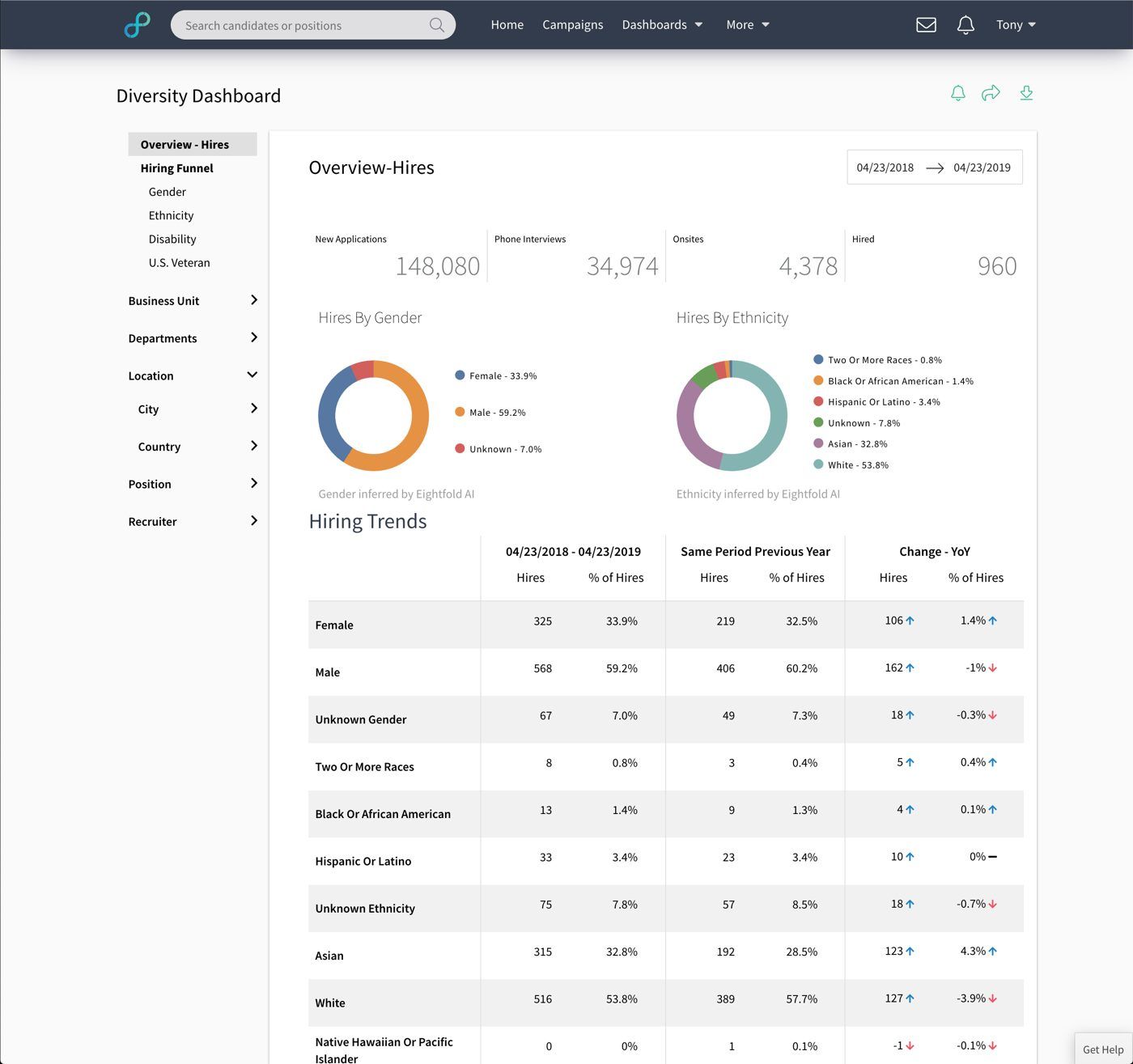
Eightfold matches candidates on skills and potential rather than pedigree, with anonymized screening that hides identifying details.
Key features
- Profile masking that anonymizes name, photo, and demographics
- Skills- and potential-based matching (Equal Opportunity Algorithm)
- Diversity dashboards and balanced-pipeline tooling
- Talent management and internal-mobility insights
Pricing: Custom (enterprise) · Rating: G2 4.2 out of 5
What users loved: skills matching plus pre-interview anonymization. "It has the feature to anonymise candidates so that there will be no biases before the actual interview." (Verified reviewer, Gartner Peer Insights)
What they flagged: match quality can be inconsistent. "Sometimes AI pulls in profiles that aren't fully aligned with the role, so the matches can feel slightly inconsistent." (Verified reviewer, Gartner Peer Insights)
Best for: enterprises that want skills-based matching and anonymized screening in one platform.
Gem
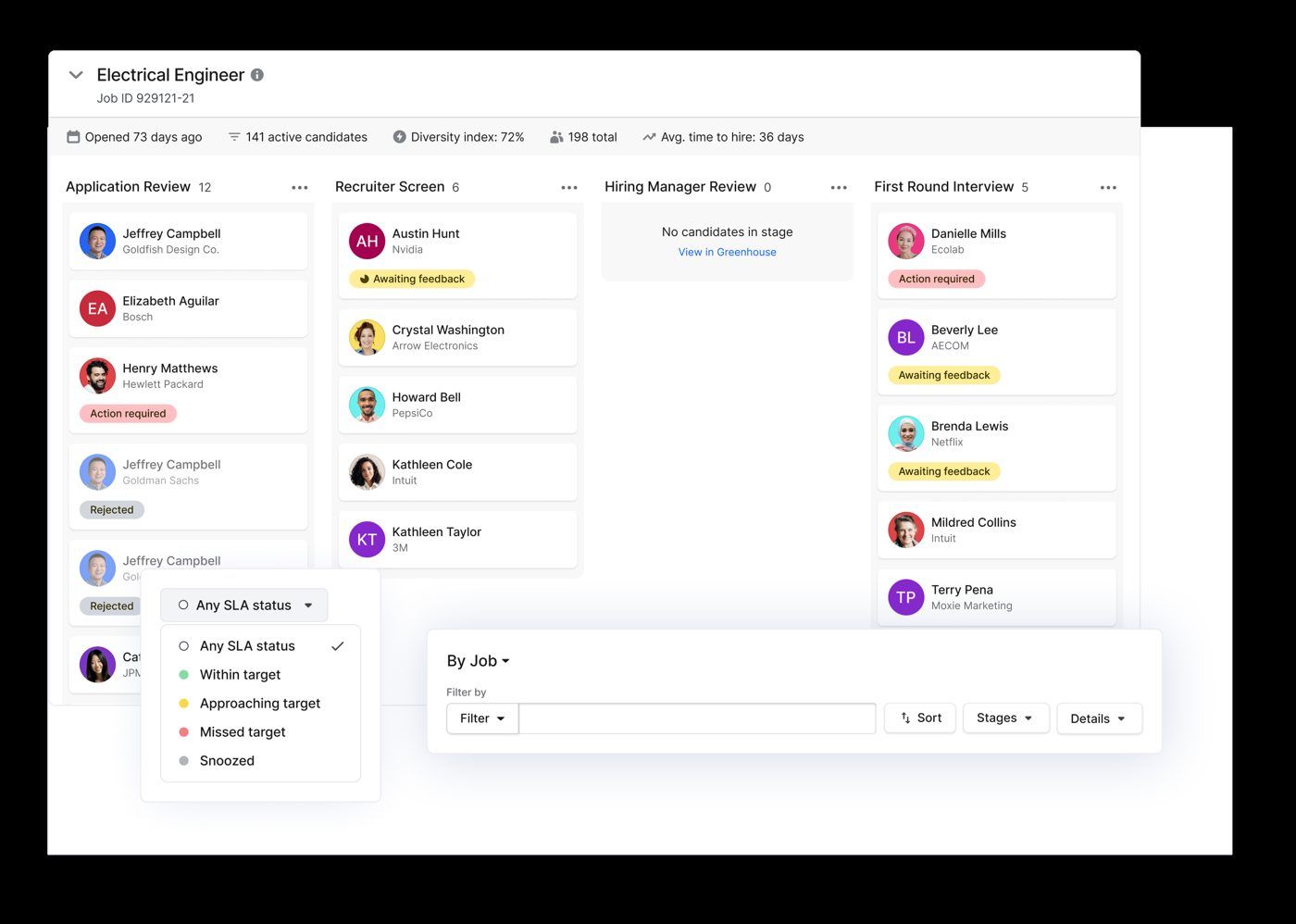
Gem combines sourcing, CRM, and an ATS with real-time diversity tracking, so you can see pipeline composition stage by stage.
Key features
- Real-time diversity analytics with demographic data
- Pipeline composition and funnel-equity analysis
- Sourcing across 800 million profiles
- ATS, CRM, and analytics in one workflow
Pricing: From $135/month; enterprise custom · Rating: G2 4.7 out of 5
What users loved: analytics and pipeline visibility beyond the ATS. "GREAT analytics, way better than our ATS's, and a really cool talent pipeline feature." (Verified HR reviewer, TrustRadius)
What they flagged: contact-finding is weaker outside the US. "Email finding function: outside USA this works really bad." (Anna L., Talent Sourcer Lead, Capterra)
Best for: scale-ups that want diversity analytics inside their daily recruiting stack.
Entelo (now Rival)
A long-standing sourcing platform now sold within Rival, with an unbiased sourcing mode that hides identifying details.
Key features
- Unbiased sourcing mode that hides identifying details
- Prebuilt diversity filters for groups like HBCUs and diversity organizations
- A passive-candidate database of 700 million-plus profiles
- ATS integrations (Greenhouse, Lever, and more)
Pricing: Custom (quote-based) · Rating: G2 4.2 out of 5
What users loved: one-click filters for intentional diverse sourcing. "Power filters that allow you to filter directly for diverse talent. It has prebuilt filters for diversity organizations, HBCUs, etc." (Michael R., Technical Sourcer, Capterra)
What they flagged: data freshness and ROI versus the cost. "The data is outdated, the cost is too high to realize an ROI. It is not intended to replace LinkedIn Recruiter." (Julie B., Director of Talent Acquisition, Capterra)
Best for: teams in the Rival ecosystem that want diversity-aware sourcing.
Bias-reduced screening and assessment tools
Skills-first evaluation is where diversity tooling has matured most, and where bias-audit rules now raise the bar.
Vervoe
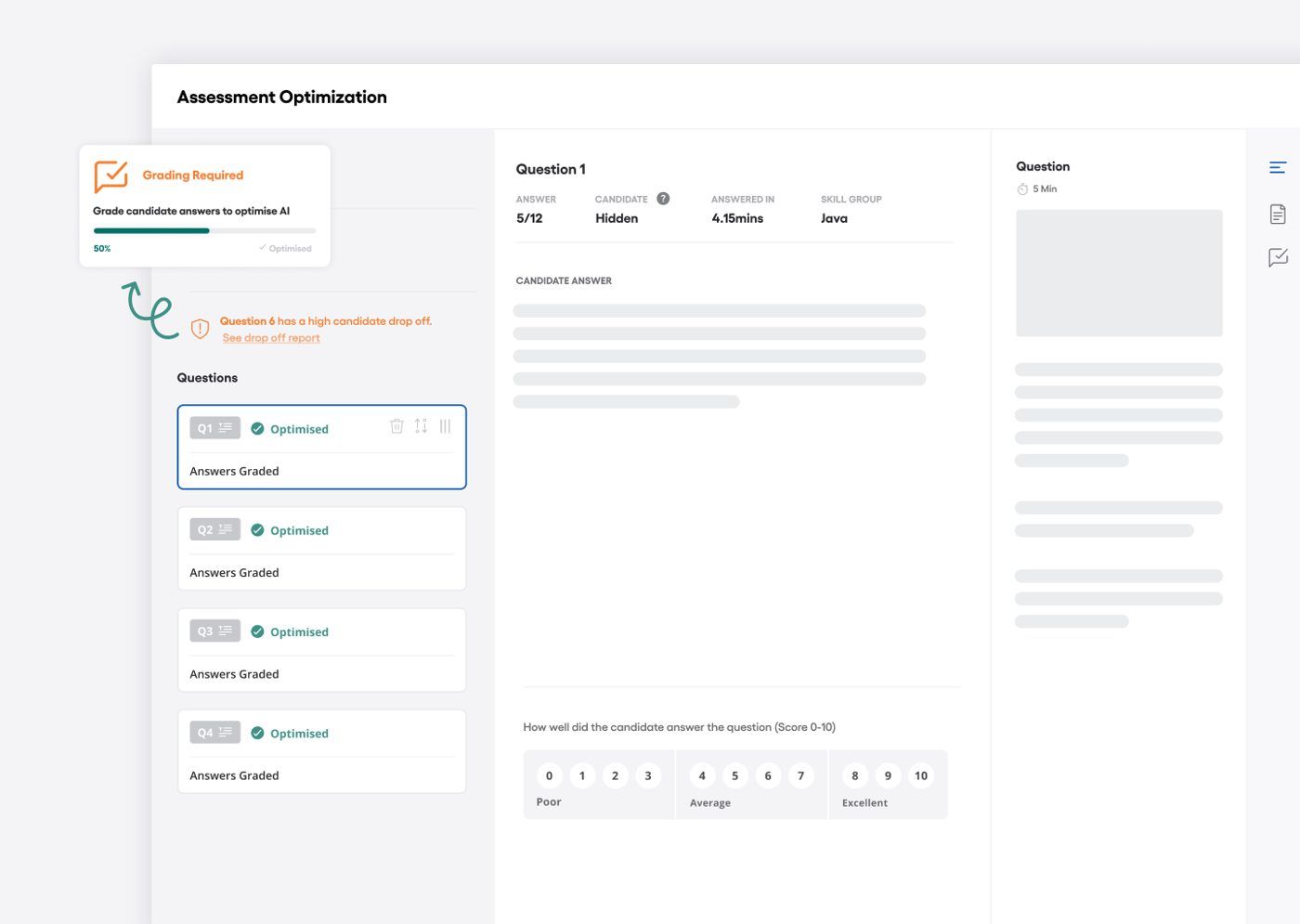
Vervoe replaces resume screening with job-related tasks and simulations, auto-graded by AI, and its scoring passed New York City's Local Law 144 bias audit.
Key features
- Job simulations and skills tests auto-graded by AI
- Independent bias auditing by Holistic AI (NYC Local Law 144 compliant)
- Scores on demonstrated skills, not pedigree or demographics
- AI screening agent and generative-AI cheating detection
Pricing: $19/month (Pay & Go) to $250/month (Growth), enterprise custom · Rating: G2 4.6 / Capterra 4.5
What users loved: it removes bias and scales screening. "The intention of Vervoe to remove the bias that occurs in the recruitment process is a highlight for me. The ability to send out hundreds of assessments at a time is a game changer." (Sandi U., Senior HR Consultant, Banking, Capterra)
What they flagged: support and occasional bugs. "Poor customer service, but great product (excluding the bugs). It takes them days to reply." (Alex L., CEO, Education, Capterra)
Best for: skills-first hiring where you want auditable, bias-tested scoring.
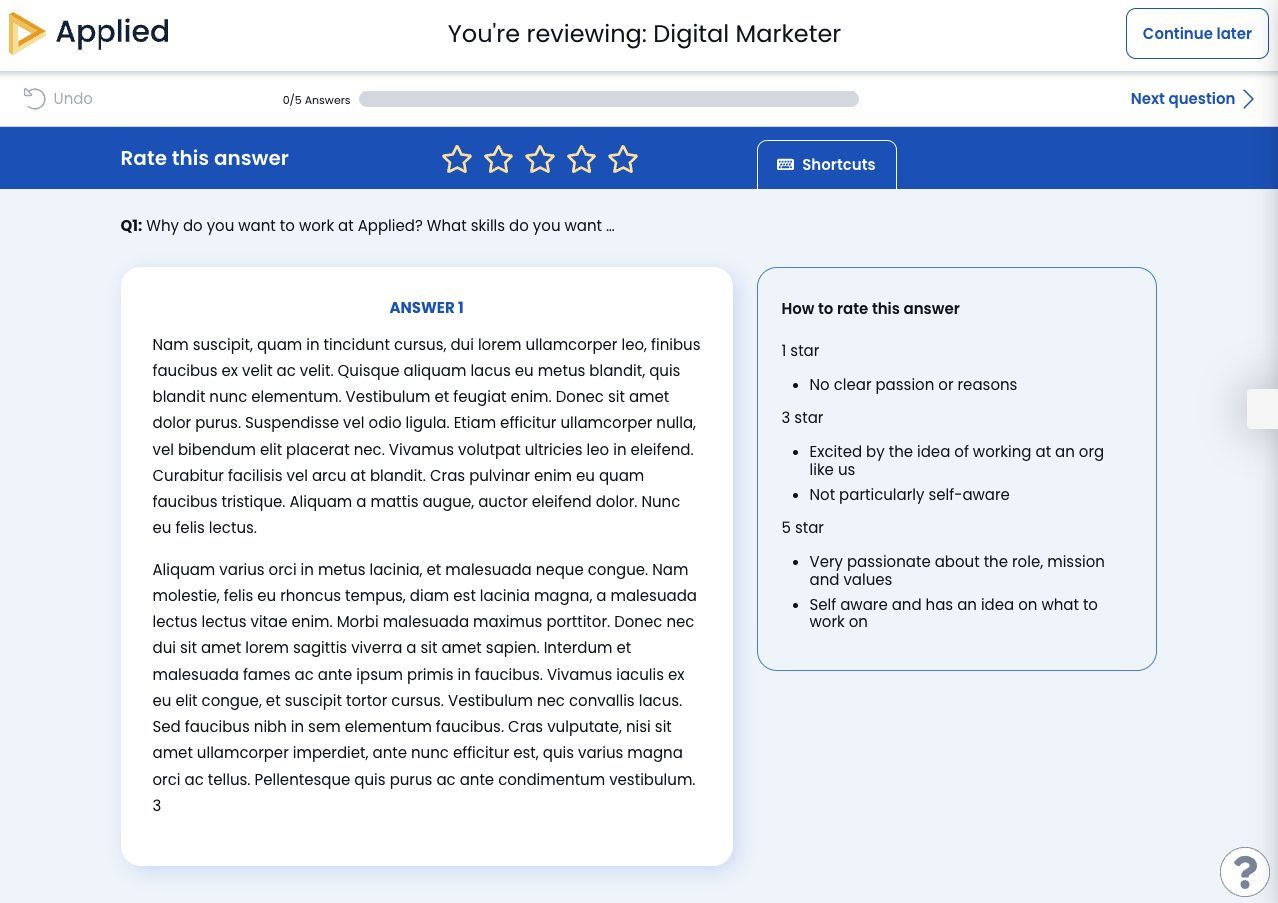
Applied
Applied was built to reduce bias: applications are anonymized and candidates are scored on structured skills questions with blind rating.
Key features
- Anonymized applications by default
- Structured skills sift with blind, randomized rating
- Diversity drop-off reporting at each funnel stage
- Predictive, evidence-based candidate scoring
Pricing: From around $200 to $299/month · Rating: Capterra 4.8 out of 5
What users loved: less bias and better-quality hires. "We've dramatically reduced unconscious bias. Candidates have been interviewed who would not have been put through based on CV alone." (Sadie L., Director of Culture and Performance, Capterra)
What they flagged: the interface can feel clunky. "The interfaces are not always super intuitive and are a little clunky to use." (Nick B., small-business user, G2)
Best for: organizations that want bias reduction built into the ATS itself.
pymetrics (by Harver)
Now part of the Harver Talent Suite, pymetrics uses gamified neuroscience assessments that are largely nonverbal to reduce cultural and language bias.
Key features
- More than a dozen gamified neuroscience assessments
- Largely nonverbal design that reduces cultural and language bias
- Fairness validation across gender, ethnicity, and socioeconomic status
- Measures potential rather than resume or credentials
Pricing: Custom (quote-based) · Rating: G2 4.6 out of 5 (Harver)
What users loved: an engaging, low-stigma assessment experience. "It doesn't feel like you are taking an assessment, it feels more like you are playing games, and results save if another company uses this platform." (Staffing and Recruiting reviewer, G2)
What they flagged: accuracy and older-candidate drop-off. "Older candidates don't like it and usually fall out from the process. Also the assessment results are not super accurate." (HR Director, G2)
Best for: high-volume and early-career hiring that should not lean on resumes.
HireVue
HireVue removed facial analysis in 2020 and now centers on structured, skills-based video interviews and assessments.
Key features
- Structured digital interviews with consistent questions and rating guides
- Skills, game-based, and coding assessments
- AI bias-audit and disclosure features
- Standardized scoring to reduce interviewer-to-interviewer variance
Pricing: Custom (enterprise) · Rating: G2 4.1 out of 5
What users loved: flexible, on-demand interviewing. "Candidates can complete interviews from their home, reducing stress and logistical challenges." (Brayden Z., Accounting, Capterra)
What they flagged: the one-way format can feel impersonal, with bias concerns. "The 'robotic' experience of talking to a camera without human interaction, and concerns regarding the potential for AI-driven bias." (Sayda E., business owner, Capterra)
Watch-out: a 2025 ACLU accessibility-bias complaint involving the platform is unresolved, so include a compliance and accessibility review before rollout.
Best for: enterprises standardizing high-volume interviews with structure.
Diversity interviewing tools
interviewing.io
Engineers practice and get evaluated in anonymous interviews, with optional real-time voice modulation to mask gender.
Key features
- Fully anonymous interviews (pseudonyms, no public profiles)
- Optional real-time voice modulation to mask gender
- Performance-based matching to employers
- Free practice fellowship for underrepresented engineers
Pricing: Custom for employers (candidates pay per session) · Rating: Limited public reviews
What users loved: realistic practice with a fast-track path. "If you do well on an interview, you can always unmask and move forward to an onsite, which is awesome." (IT and Services reviewer, G2)
What they flagged: price is a barrier. "The pricing structure can be a barrier and should offer different models, especially suited for startups." (Telecommunications reviewer, G2)
Best for: technical hiring that wants identity-blind, performance-based evaluation.
Diversity job boards and talent communities
Circa and DiversityJobs
Now part of Mitratech, Circa distributes roles to state employment boards and more than 15,000 community organizations, with DiversityJobs syndicating to affinity sites.
Key features
- Distribution to state employment boards and 15,000-plus community organizations
- DiversityJobs syndication to affinity job sites
- OFCCP and VEVRAA compliance documentation
- Diversity report cards and a resume database
Pricing: From $295/post; subscriptions custom · Rating: G2 4.2 out of 5
What users loved: hands-off compliance and responsive service. "A responsive team, a simple and expert system, reasonable pricing, and flawless execution." (Stephen G., VP of HR Operations and Compliance, Capterra)
What they flagged: applicant volume can disappoint. "I feel we should be receiving more applicants, which leads me to wonder how much those looking for a position know of the site." (Jeff W., Director of Talent Acquisition, Capterra)
Best for: US employers and federal contractors who need diverse reach plus compliance proof.
PowerToFly
PowerToFly pairs a large diverse-talent community with employer branding, virtual career fairs, and DEIB upskilling.
Key features
- Large diverse-talent community with AI candidate search
- DEI-focused virtual career fairs
- Employer-branding company pages and content
- DEIB learning and upskilling resources
Pricing: Custom (quote-based) · Rating: G2 4.8 out of 5
What users loved: diverse, global talent and a real partnership. "At Zapier, we've truly valued our partnership with PowerToFly. They have connected us with exceptional talent around the world." (Kim W., Senior Manager of Talent Attraction, G2)
What they flagged: more senior candidates would lift ROI. "It would be great to see more mid-to-senior-level talent from PowerToFly, which would provide a stronger ROI." (Kim W., G2)
Best for: employer branding and direct engagement with diverse communities.
Fairygodboss (by The Muse)
Now part of The Muse, Fairygodboss is the largest online career community for women, used to reach and attract female talent.
Key features
- Branded employer profiles aimed at women candidates
- Job promotion to a large women's community
- Virtual career fairs and events
- Company reviews and ratings written by women
Pricing: Custom (packages) · Rating: Limited product reviews
What stands out: strong engagement with women candidates, with the platform reporting up to a 50% lift in applications from women.
What to consider: independent expert reviews note thin job inventory and opaque pricing, and it is not listed as a software product on G2 or Capterra, so treat these as expert-review signals rather than large-sample ratings.
Best for: employers focused on attracting and retaining women.
Fair-chance background check tools
Checkr
Checkr is one of the few screening tools with explicit fairness tooling, including a Fair Chance assessment that evaluates records in context rather than auto-disqualifying.
Key features
- Fair Chance assessment that weighs records in context
- Candidate Stories for added context on records
- Programmatic record filtering to reduce inconsistent manual review
- EEOC-aligned analytics and adverse-action workflow
Pricing: $29.99 to $89.99 per report; enterprise custom · Rating: G2 4.5 out of 5
What users loved: smooth integrations and easy ordering. "It seamlessly integrates with our Paylocity system, so it feels as though it is a one-stop-shop making our pre-employment checks easy." (Sara S., Director of HR, Capterra)
What they flagged: inconsistent turnaround and thin support. "Unreliable timeframes: sometimes you receive a background check quickly, other times it takes weeks with little help from customer support." (Taylor S., Capterra)
Best for: employers who want compliant, fair-chance background checks at scale.
DEI benchmarking and analytics tools
Fair360 (formerly DiversityInc)
Best known for its annual Top 50 Companies benchmarking survey, Fair360 lets employers benchmark programs against best-in-class peers.
Key features
- Top 50 and Workplace Fairness benchmarking survey
- Benchmarks across women, people of color, disability, LGBTQ+, and veterans
- Free participation report card plus premium tiers
- Editorial content, webinars, and recognition
Pricing: Free survey participation; premium tiers custom · Rating: Not a software listing
What stands out: a respected, data-driven benchmark, with a Top 50 placement widely treated as a credibility marker.
What to consider: some question the self-reported ranking methodology and the cost of premium participation, so use it as one external signal rather than your whole DEI strategy.
Best for: larger employers, generally those with 750 or more US staff, that want external benchmarking and recognition.
Diversio
Diversio measures inclusion through survey data and recommends concrete actions, used by large enterprises to track representation over time.
Key features
- Inclusion measurement via employee surveys
- AI-driven recommendations for action
- Representation tracking dashboards
- Industry benchmarking
Pricing: Custom (quote-based) · Rating: No independent reviews yet
What stands out: an interactive analytics dashboard and a proprietary Inclusion Score, with customers citing measurable gains.
What to consider: there are no independent reviews yet on G2, Capterra, or Software Advice, and pricing is quote-only and aimed at mid-market and enterprise, so scope a pilot before committing.
Best for: enterprises that want to quantify and track inclusion, not just hire for it.
Project Include
Not software but a free, openly licensed library of DEI recommendations, including a practical hiring module.
Key features
- Free Creative Commons DEI recommendations, including hiring
- 87 recommendations across 14 areas of the employee lifecycle
- A startup self-assessment to generate next steps
- Research reports and case studies
Pricing: Free · Rating: Not a software listing
What stands out: a comprehensive, no-cost playbook widely referenced as a starting point for inclusive hiring.
What to consider: it is guidance, not tooling, so there is no software, automation, or support; you implement the recommendations yourself, and they are opinionated by design.
Best for: teams that want trusted, free guidance before investing in tooling.
Comparison at a glance
| Tool | Category | Best for | Pricing (2026) | Rating |
|---|---|---|---|---|
| Textio | Inclusive language | One standard across hiring and feedback | Custom | G2 4.2 |
| Datapeople | Inclusive job descriptions | Language guidance plus funnel analytics | Custom | G2 4.4 |
| Ongig | Inclusive job descriptions | High-volume JD standardization | From $4,900/yr | Limited reviews |
| SeekOut | Diversity sourcing | Best-in-class diverse sourcing at scale | Custom | G2 4.5 (750+) |
| LinkedIn Talent Insights | Talent intelligence | Workforce and diversity planning | Custom | G2 4.5 / Capterra 4.6 |
| Eightfold AI | Talent intelligence | Skills matching plus anonymized screening | Enterprise custom | G2 4.2 |
| Gem | ATS/CRM plus DEI analytics | Diversity analytics in daily workflow | From $135/mo | G2 4.7 |
| Entelo (now Rival) | Diversity sourcing | Diversity-aware sourcing in Rival | Custom | G2 4.2 |
| Vervoe | Skills assessment | Auditable, bias-tested scoring | $19 to $250/mo, custom | G2 4.6 / Capterra 4.5 |
| Applied | Blind skills-based ATS | Bias reduction built into the ATS | ~$200 to $299/mo | Capterra 4.8 |
| pymetrics (Harver) | Game-based assessment | High-volume, early-career, potential-first | Custom | G2 4.6 (Harver) |
| HireVue | Video interviewing | Structured high-volume interviews | Enterprise custom | G2 4.1 |
| interviewing.io | Anonymous interviewing | Identity-blind technical hiring | Custom (employers) | Limited reviews |
| Circa and DiversityJobs | Job board plus compliance | Diverse reach plus OFCCP compliance | From $295/post | G2 4.2 |
| PowerToFly | Community plus branding | Employer brand to diverse communities | Custom | G2 4.8 |
| Fairygodboss (The Muse) | Women's community | Attracting and retaining women | Custom | Limited reviews |
| Checkr | Fair-chance background checks | Compliant, fair-chance screening | $29.99 to $89.99/report | G2 4.5 |
| Fair360 | Benchmarking | External benchmarking and recognition | Free plus premium | Media |
| Diversio | DEI analytics | Quantifying and tracking inclusion | Custom | No reviews yet |
| Project Include | Open playbooks | Free guidance before tooling | Free | Nonprofit |
How to choose a diversity recruiting tool
Start with where you actually lose diverse candidates, then pick the tool that fixes that stage. Losing people at the job-ad stage points to inclusive-language tools; a thin top of funnel points to sourcing; drop-off in screening points to skills assessment. Check that any tool integrates with your ATS, ask for an independent bias audit and compliance support for anything with AI scoring, insist on funnel-level diversity analytics rather than vanity metrics, and match the choice to your size and region.
The Matchr take
As a global embedded RPO partner, we at Matchr see the same pattern across markets: tools are very good at widening the funnel and removing obvious bias, but they do not make the hire. They raise the baseline. Human judgment, applied consistently and with care, still decides who gets the offer and whether they stay.
The teams getting real results in 2026 are not the ones with the longest tool stack. They are the ones who pair a few well-chosen tools with a clear, skills-based process and run it the same way every time. That is also where an embedded partner helps: building inclusive sourcing, structured screening, and fair interviewing into your existing systems, so the intent in a job description survives all the way to the offer. For more on that model, see what embedded recruitment is and how it works and our comparison of recruitment models.
Frequently asked questions
What are diversity recruiting tools? Software and platforms that help employers attract, source, screen, interview, and measure candidates in ways that widen the talent pool and reduce bias, from inclusive job-description writers and sourcing engines to blind assessments, fair-chance background checks, and DEI analytics.
What is the best diversity recruiting tool in 2026? There is no single best tool; it depends on the stage you want to improve. For sourcing, SeekOut leads; for skills-based assessment, Vervoe; for a blind, structured ATS, Applied; for inclusive job ads, Textio or Datapeople; for fair-chance background checks, Checkr.
Do diversity recruiting tools actually reduce bias? They reduce specific, well-understood biases such as biased language, resume-based pedigree screening, and inconsistent interviews. They do not remove human judgment, and poorly configured AI tools can introduce new bias, so independent audits and a structured process still matter.
How much do diversity recruiting tools cost in 2026? From free (Project Include) and per-report pricing (Checkr from $29.99) to monthly SaaS (Vervoe from $19, Gem from $135) and custom enterprise contracts. Most sourcing and enterprise tools are quote-based.
Are AI hiring tools legal and compliant? Rules are tightening. New York City's Local Law 144 requires bias audits for automated hiring tools, the EU AI Act adds obligations for high-risk hiring systems, and pay-transparency rules are expanding in Europe. Favor vendors that publish bias audits and compliance documentation.
What features should a diversity recruiting tool have? Look for the capability that matches your gap: inclusive-language guidance, diversity sourcing filters, blind or skills-based screening, structured interviewing, fair-chance assessment, and funnel-level diversity analytics, plus ATS integration and a published bias audit for any AI scoring.
The right stack will not build a diverse team on its own. It clears the obstacles so your judgment, and your hiring managers' judgment, can do its best work. Choose a few tools that fit your process, run that process consistently, and treat the data as a feedback loop rather than a scoreboard.
Need help building diverse teams at scale across markets? Let's get in touch.