
Recruitment
Hiring for AI Infrastructure: 5 Problems That Break Talent Teams (and the Solutions That Work)
Five structural problems break talent teams at AI infrastructure scale-ups. Here is each one, with the numbers behind it and the solution that works.

The Global Embedded RPO Company
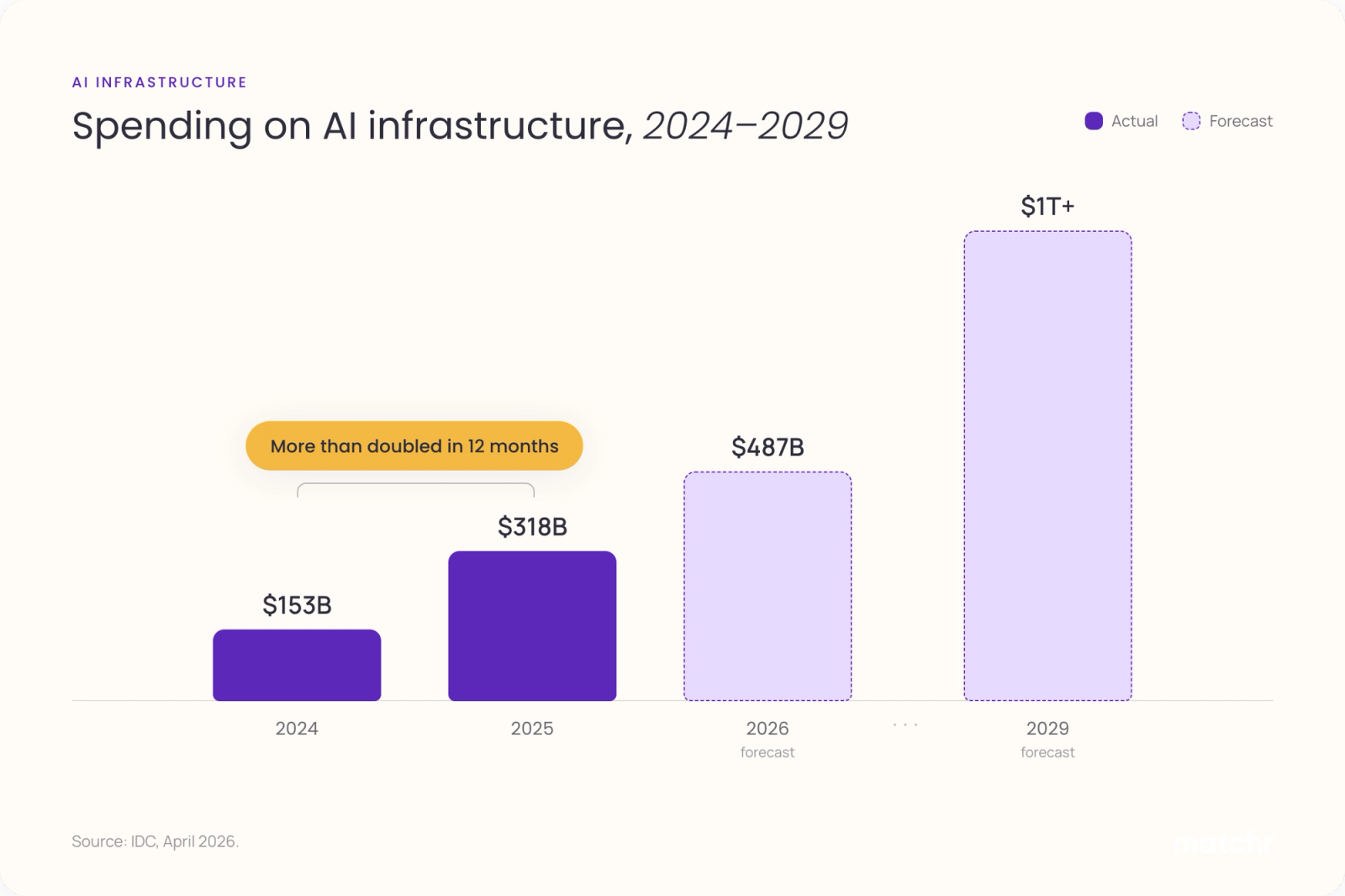
AI infrastructure hiring is where well-run talent functions go to get humbled. The capital is committed, the compute is being built, and the hiring plan lands on the talent team's desk with a deadline set by a funding round. Worldwide AI infrastructure spending more than doubled in a single year, from $153 billion in 2024 to $318 billion in 2025, and IDC forecasts more than $1 trillion by 2029. The people needed to design, build, and run that infrastructure did not double with it.
We at Matchr run embedded recruitment inside this market. This guide covers the five problems we see break talent teams at AI infrastructure scale-ups, and the solution that works against each one.
The five, in one view:
- The talent pool is so small the labor statistics cannot count it → match recruiter depth to candidate depth
- The talent lives where you are not → make geography a per-requisition decision, before sourcing starts
- You are bidding against the deepest pockets in tech → compete on package shape and a trained equity narrative
- Agency dependency scales faster than your hiring discipline → run the displacement math and move volume desks off agencies
- Your scaling window is shorter than your ramp time → internal team plus embedded specialists who are live in week one
One line to keep: in AI infrastructure, the talent function is a strategic constraint on the business, equal to power, GPUs, and capital.
Problem 1: The talent pool is so small the labor statistics cannot count it
The US Bureau of Labor Statistics counts 286,760 mechanical engineers, 188,790 electrical engineers, and 93,940 electronics engineers. What it cannot tell you is how many of them hold operational data center experience, because data center experience is not an occupational code. There is no census of the exact skill the entire AI infrastructure economy depends on.
Industry voices cite framings like "only 1% of mechanical and electrical engineers have data center experience." We could not verify that figure against a primary source, and we say so openly. The absence is the point: when the labor data cannot count the experience you need, that experience is scarce by definition.
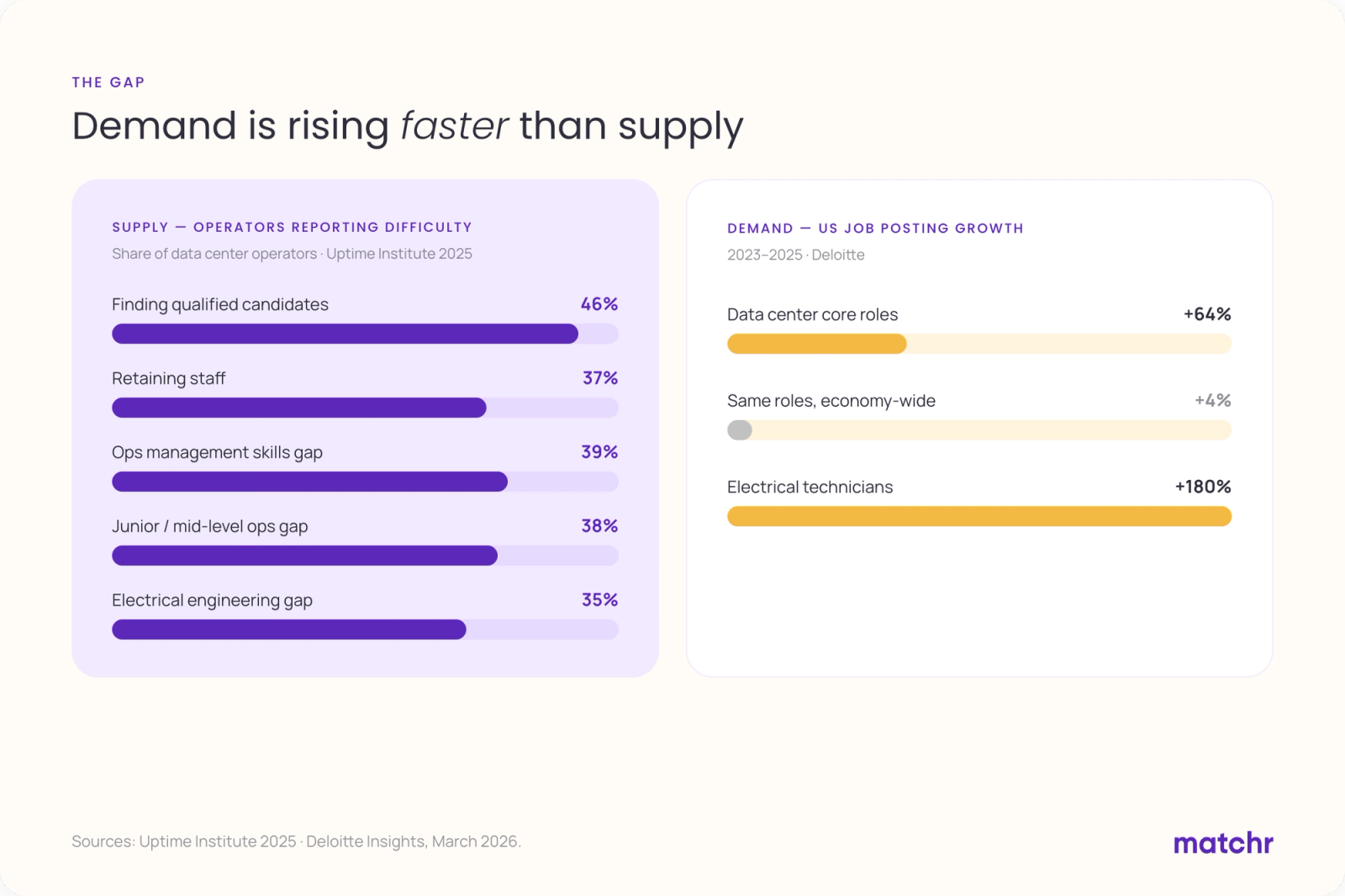
The hidden half of this problem sits on your side of the table. A recruiter who can credibly source, screen, and close inside a pool this rare is a specialist too, and those recruiters are nearly as scarce as the engineers. A generalist cannot tell a real data center CV from one that simply has the right words on it, and senior candidates can tell inside one call whether the person approaching them knows the domain.
The solution: match recruiter depth to candidate depth
- Audit every specialist desk. For each hard desk (data center design, commissioning, operations, hardware), ask one question: does the recruiter's own track record match the people they are evaluating? If the answer is no, that desk is your bottleneck.
- Screen recruiters like you screen engineers. Three questions that expose depth fast: "Walk me through how you would source a commissioning engineer for a 100MW build." "How do you verify real data center experience versus a keyword-matched CV?" "Which three communities or channels actually produce candidates in this niche?" Vague answers mean a generalist.
- Never run a niche desk with a solo generalist. If you cannot hire a domain recruiter, pair the generalist with a domain lead who calibrates every shortlist before it reaches a hiring manager.
- Measure submit-to-interview rate per desk. It is the cleanest calibration signal. If you submit ten profiles to get one interview, the desk is guessing.
Problem 2: The talent lives where you are not
Data center talent concentrates where data centers already run. Northern Virginia leads the world with 3,046 megawatts of installed capacity; Atlanta follows at 1,279. Inside the US, California and Texas together hold 27% of data center employment, and five states hold more than 40% of the total, according to the US Census Bureau.
The operational consequence, from our research: a senior data center engineering role designed as five days on-site in a non-cluster metro can take nine to twelve months to fill from local supply. The same role, sourced from Northern Virginia or Atlanta with a hybrid or relocation package, fills in two to three months. Most teams discover this in month five of a stalled search, which is the most expensive possible moment.
The solution: make geography a decision, not a discovery
- Classify every requisition before sourcing starts. Two buckets: cluster-available (the profile exists in NoVA, Atlanta, Bay Area, DFW) or local-only (the role physically cannot move). Be honest about which is which.
- Set the on-site policy at intake, not at offer stage. Five days on-site in a non-cluster metro is a 9-to-12-month decision. Hybrid with travel, or relocation support, is a 2-to-3-month decision. Put those two numbers in front of the hiring manager and let them choose with eyes open.
- Budget relocation against vacancy cost, not against salary. A senior engineer's relocation package looks expensive until you price three quarters of an unfilled seat on a build schedule. Missed hires become missed megawatts, and that cost lands on revenue, not on HR.
- Build your sourcing map from capacity data. CBRE and JLL publish where installed megawatts sit; engineering staff concentrate in the same metros. That list is your sourcing geography, updated yearly.
Problem 3: You are bidding against the deepest pockets in technology
A senior hardware engineer at Google earns a median $385,000 in total compensation, with stock around 36% of the package. One level up, $541,000. AWS lists sign-on payments and RSUs as standard components on data center roles, a structural recruiting weapon rather than an occasional lever. Most US neoclouds run a published cash gap of 15 to 25% against those offers, and the total-package gap is materially larger once equity is layered in.
Here is what we observe across our embedded engagements: the scale-ups that win senior hires from hyperscalers are rarely the ones offering the largest cash package. They are the ones whose hiring managers and recruiters can explain, with conviction and specifics, why an equity stake in a fast-growing AI infrastructure company is worth more in five years than the same person's RSU vest at AWS.
The solution: fix the package shape, then train the narrative
- Benchmark against hyperscaler total compensation, not local salary surveys. If your reference point is the regional market and the candidate's reference point is Levels.fyi, you are negotiating in different currencies.
- Rebuild the package architecture. Structured equity with a clear vesting story, sign-on cash to bridge what a candidate walks away from, and refresher logic for retention. Headline base salary is the least flexible and least decisive component.
- Write the equity narrative down. One page: the growth trajectory, the revenue multiple logic, what the stake could be worth in five years and under what assumptions. Honest, specific, no hype.
- Train every hiring manager and recruiter to deliver it. The narrative fails when it lives only in the founder's head. If the fourth interview cannot articulate why the equity matters, the offer stalls exactly there.
- Pre-agree walk-away bands. Decide the ceiling before the process starts, so counters are answered in hours, not committee weeks. Speed is part of the offer.
Problem 4: Agency dependency scales faster than your hiring discipline
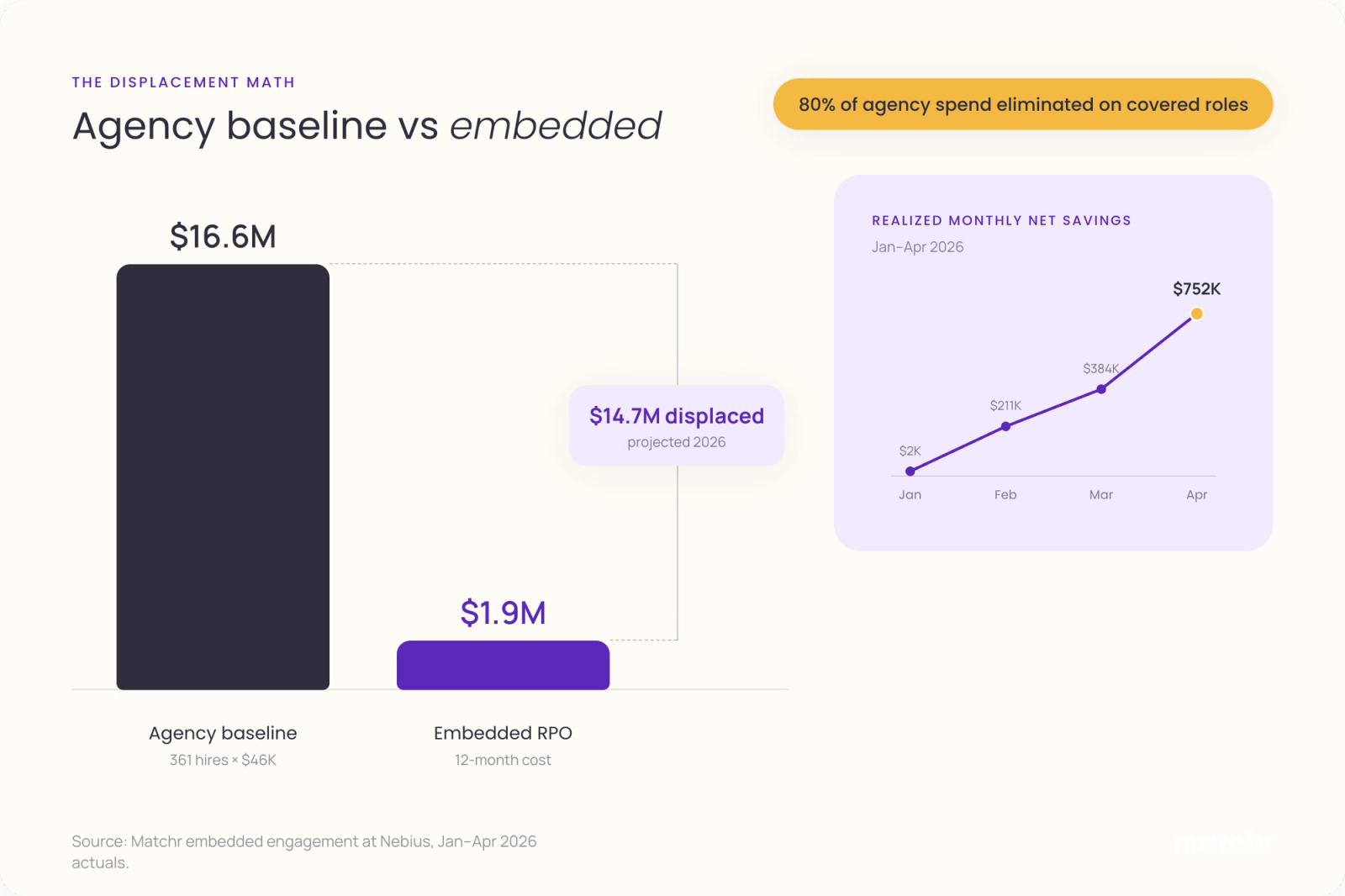
At $46,000 per senior placement, agencies are workable for the occasional impossible role. At AI infrastructure volume they become a financial liability. A 361-hire annual roadmap at that baseline is a $16.6 million agency cost. That is not a recruiting line item. It is a strategy problem hiding in accounts payable.
The displacement math from our Nebius engagement: an embedded RPO model running at approximately $1.9 million for the year against that same roadmap, with $1.3 million in net agency savings realized in the first four months and $14.7 million projected for the full year. 80% of agency spend on the roles we work on has been eliminated. Net monthly savings ramped from $2,000 in January to $752,000 in April as the embedded team reached steady state.
The solution: run the displacement math, then move desk by desk
- Compute your own baseline. Planned hires × your average agency fee. Write the number down and share it with the CFO; it reframes the conversation instantly.
- Segment your roles. Agencies stay for genuinely one-off searches (a niche executive, a single hard role in a new market). Every desk with repeatable volume is a displacement candidate.
- Move volume desks to embedded, outbound-led sourcing. Inbound does not reach a pool this rare; the candidates are not applying, they are being courted.
- Track net displacement monthly. Savings ramp as the embedded team reaches steady state; expect an onboarding month, then compounding. The target shape is agency spend eliminated on covered roles, not supplemented.
Problem 5: Your scaling window is shorter than your ramp time
A specialist internal recruiter takes around six months to reach productivity in this market. The scaling window does not wait: CoreWeave went from 881 to 2,189 employees in twelve months. Nebius entered 2026 at around 700 people with a roadmap toward 3,000 and 361 senior hires across data center, GTM, R&D, and corporate functions, supported by a twelve-person internal TA team.
As Marcus Pask, Talent Acquisition Leader at Nebius, put it: "Scaling internally would have been too slow, and leaning on agencies would have been expensive and fragmented." He tells the full story on our Leaders in Talent podcast: Hiring the People Behind the AI Boom, on scaling Nebius from 300 to 3,000.
The solution: internal plus embedded, sequenced deliberately
- Plan with the six-month constant. Every internal specialist recruiter you hire today is productive in two quarters. Map that against your capex and funding milestones; the gap you see is the problem.
- Cover the gap with embedded specialists who start productive. On our Nebius engagement, thirteen senior partners were productive in week one and first offers went out inside month one, not month six.
- Set week-one and month-one bars in the contract. Partners live inside your systems in week one; first offers inside the first month. If a provider cannot commit to that, it is an agency with a different invoice.
- Protect continuity. The recruiter who closed your last senior data center engineer should close the next one. Context compounds; rotation destroys it.
- Build internal capability underneath. Embedded is not a replacement for an internal function; it is the bridge that lets you build one without missing the window.
What the talent leaders see coming
The pressure is not unique to infrastructure; it is the sharpest case of a market-wide shift. In our Talent Acquisition Trends 2026 report, Krista Tichelaar, Executive Recruitment Partner & Projects Lead at SWIFT, puts it plainly: "Skills shortages will also increase in 2026, driving higher salaries for specialized roles and increasing competition for top talent." She expects companies to "shift more toward contracting roles, hiring niche, critical skills and outsourcing certain roles."
Lauryna Gireniene, Head of Talent Acquisition at Nord Security, frames the same shift from the operating side: "Companies are transitioning from a talent-driven to a business-driven market." AI infrastructure is where that transition runs hottest, because the business case is measured in megawatts and the talent pool is measured in fractions of a percent.
For first-hand accounts of scaling under these conditions, two more Leaders in Talent conversations are worth your time: Tracy St.Dic on how Zapier raised the hiring bar for AI fluency, and Wesley Gilbert on hypergrowth hiring at On, Uber, and ManyChat. And for the broader market numbers behind these shifts, our Recruitment Statistics 2026 hub is the running reference.
Everything in this guide is the work we do every day. If you are scaling an AI infrastructure team and want to see how embedded support works in practice, from a single specialist desk to a full talent function, explore what we do for AI infrastructure.
FAQ
Why is AI infrastructure hiring so difficult?
Three structural reasons: the specialist pool is tiny (data center experience is not an occupational code in US labor statistics), the talent concentrates in a handful of metros led by Northern Virginia, and hyperscalers set compensation expectations most scale-ups cannot match on cash. Demand keeps rising: US data center job postings grew 64% between 2023 and 2025, against 4% for the same roles economy-wide, according to Deloitte.
How long does it take to hire a data center engineer?
From local supply in a non-cluster metro, nine to twelve months for a senior on-site role. Sourced from cluster markets like Northern Virginia or Atlanta with a hybrid or relocation package, two to three months. The difference is a design decision owned by the talent function.
What does agency recruiting cost for AI infrastructure roles?
Senior placements run around $46,000 each. At scale-up volume, a 361-hire roadmap carries a $16.6 million annual agency baseline, which is why displacement through embedded models has become the dominant cost move in this market.
What is embedded RPO for AI infrastructure?
Embedded RPO places dedicated senior recruiters inside your team, systems, and hiring-manager meetings, working as an extension of the organization rather than an external agency. In this market it addresses three constraints at once: specialist access, ramp speed, and agency cost. See our guide to what embedded recruitment is, our comparison of recruitment models, or go straight to what we do for AI infrastructure.
Scaling AI infrastructure and rethinking your talent model? Let's get in touch.