
Growth & Scaling
How to Manage Distributed Teams: Lessons from Atlassian, GitLab and More
Best practices for managing and scaling global remote teams.

Marketing Manager · Tidaro

“We want to hire and retain the best people in the world. If we limited our talent pool to a commuting radius around our offices, we would be at a significant disadvantage. The best people live everywhere, not concentrated in one area. And by recruiting from a diverse set of communities, we will become a more diverse company. “ – Brian Chesky, co-founder and CEO of AirBnB.
The ability to hire employees worldwide brought many companies a lot of advantages, Airbnb being one of the many success stories.
And here’s another example: Dropbox.
Dropbox has over 2,000 remote workers in 11 countries, and they work in a “Virtual First” environment, from engineers to customer care. The Dropbox “Virtual First” policy appears to be a game-changer for their recruitment. The number of applications per job post nearly doubled, while offer acceptance rates have jumped 126%, suggesting that location flexibility is something top talent is searching for.
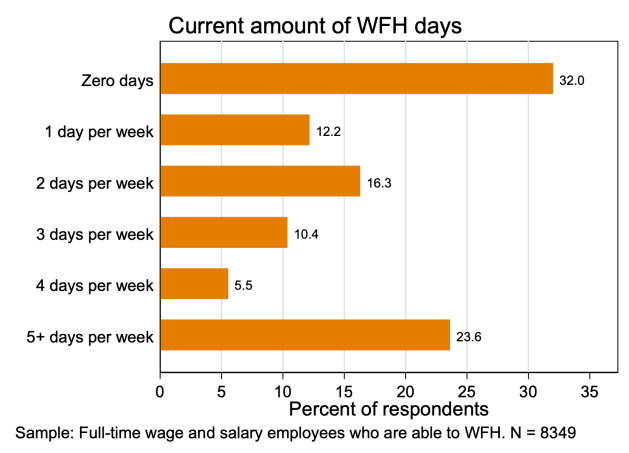
WFH research shows that 23.6% of employees in a US survey (data is from December 2024 to April 2025) were working 5+ days from home. Only 32% of workers were working only in-office.
So, there are many companies out there really thriving in remote environments.
In this article, I’m going to show you how companies can benefit from hiring remotely as well as show you success stories of companies that manage distributed teams (Atlassian, GitLab, and Airbnb).
Let’s go!
The Benefits of Hiring Remotely

1. Access to a bigger pool of candidates, as well as a more diverse one
When a company removes geographical constraints its candidate pool expands exponentially. Instead of limiting searches to a certain radius around its office, it can find the perfect specialist regardless of where they live. Else, it would have to consider people less skilled for the job, and let’s face it, even more expensive – because this is a demand and offer issue. Remember those days when a company would “steal” developers from another company, because there weren’t too many options available?
An analysis of over 10,000 employers and 122 different applicant tracking systems (e.g., Greenhouse, Workday, and SmartRecruiters) concluded that remote jobs attract 2.2x more candidates than non-remote jobs.
Also, remote jobs attract 2.2x more women than non-remote jobs.
2. Reduced hiring costs
Remote recruitment eliminates expenses associated with traditional hiring—office space for interviews, candidate travel reimbursements, relocation packages, and physical onboarding resources.
Now, there might be a cost if you hire an employer of record. But, there’s always the option of B2B contracts.
Also, finding a recruitment partner is also helpful when trying to source from outside your own country.
3. Paying local rates salaries
This is one of the biggest benefits when hiring remotely.
Let’s take a look at Gitlab’s example: “We are paying local rates based on the cost of the labor market. There is no cost of living input in our compensation philosophy.
Compensation aims to be at a competitive rate for your job family, your location, your level, your experience, and your contract type[…]. We hire across the globe, but we’re not location agnostic. Your timezone, the location factor in your region, and the vicinity to users, customers, and partners can all be factors.” They also say that they pay the average salary or above it.
And paying local rates makes sense, because, at the end of the day, it’s about the purchasing power that differs from country to country.
4. Operate continuously across time zones
Maybe you are a big company headquartered in Germany but selling to South America. Wouldn’t you feel it would be wise to have customer support employees located there? They would be speaking native Spanish or Portuguese, and they could perfectly match the time zone needs.
With team members across different time zones, companies can maintain operations around the clock without requiring shift work. This distributed approach allows for continuous customer support, development cycles, and global market coverage.
How Atlassian’s “Team Anywhere” Is Empowering Employees to Collaborate Effectively across Borders
Atlassian is a global company, with over 10,000 employees on 5 continents, headquartered in Sidney, Australia. Atlassian is the creator of famous tools such as Jira, Trello, or Confluence.
They are also famous for their “Team Anywhere program”, which allows them to manage globally distributed teams, while also attracting top talent from around the world.
Atlassian gives team members control over their work setup, with options for fully remote, in-office, or hybrid working. This flexibility helps employees successfully juggle professional responsibilities alongside personal commitments and interests. Atlassians can establish their home base in any of the company’s 13 global locations and have the freedom to work temporarily from different places.
91% of the Atlassian employees say this program it’s an important reason why they stay at the company. And this is also one of the reasons why Atlassian has been nominated in the Best Places to Work 2023 by Glassdoor as well as Fortune. The program worked like a boosters for their employer branding.
1000 days after launching Team Anywhere, Atlassian wrote a case study with their conclusions on this new way of working. Here’s a shortlist:
- Atlassians save about 10 days/year from skipping commutes.
- 92% of Atlassians say their distributed work policy allows them to do their best work.
- The number of candidates per role is more than 2x higher.
- Candidate offer accept rate has increased 20%.
- There was no productivity slowing down.
- Important real estate annual savings: Atlassian believes that without the program, they would have needed twice the office space they have.
- Representation of women at Atlassian in India is more than 2x higher.
- Employees spend 13% less time in meetings and report a 32% improvement in focus.
- Atlassian’s strategically planned in-person gatherings led to a 27% increase in feelings of connection, and this boost lasts 4-5 months.
Other important lessons from Atlassian:
- Atlassian is focusing on measuring productivity using outcomes, not tasks. They set clear, ambitious goals and made sure they’re visible across all the company. They work with OKRs (Objectives and Key Results). Each OKR has a single dedicated leader. The OKRs are immutable – once created they are never edited, only retired and re-created.
- Here’s how work happens inside Atlassian: meetings shouldn’t take up no more than 30% of the week, open collaboration should account for 10 – 20% of the week, focus time must be about 30-40% of the week.
- Ideally, employees would book slots for responding to messages.
- Employees are encouraged to jump into shorts calls as well as make use of loom videos to clarify tasks or provide more details.
What Can We Learn from GitLab’s Remote Handbook
GitLab, an all-in-one AI-powered DevSecOps platform, is a remote-only company that grew from 1350 employees in 2021, to 2375 in 2025, all of them working in more than 70 countries.
GitLab recognizes the strategic benefits of remote recruitment beyond just gaining an edge over competitors. The remote hiring process often moves more quickly, with virtual assessments and interviews providing excellent cost efficiency. By tapping into talent pools that traditional companies might miss, GitLab has built a team that’s both genuinely diverse and highly skilled. The company is experiencing tangible returns from this approach to staffing.
But, in order to create a winning global team, a company needs the proper processes. And GitLab has created a bullet-proof one. It’s called The Handbook.
GitLab’s openly viewable internal wiki, the GitLab Handbook, functions as the definitive source for the organization’s guidelines, procedures, operational flows, and cultural values. It reflects the company’s commitment to prioritizing documentation over informal exchanges—a “handbook-first” philosophy that supports effective remote collaboration across different time zones.
You can check out The Handbook here. It is mindblowing. It’s the mere definition of transparency.
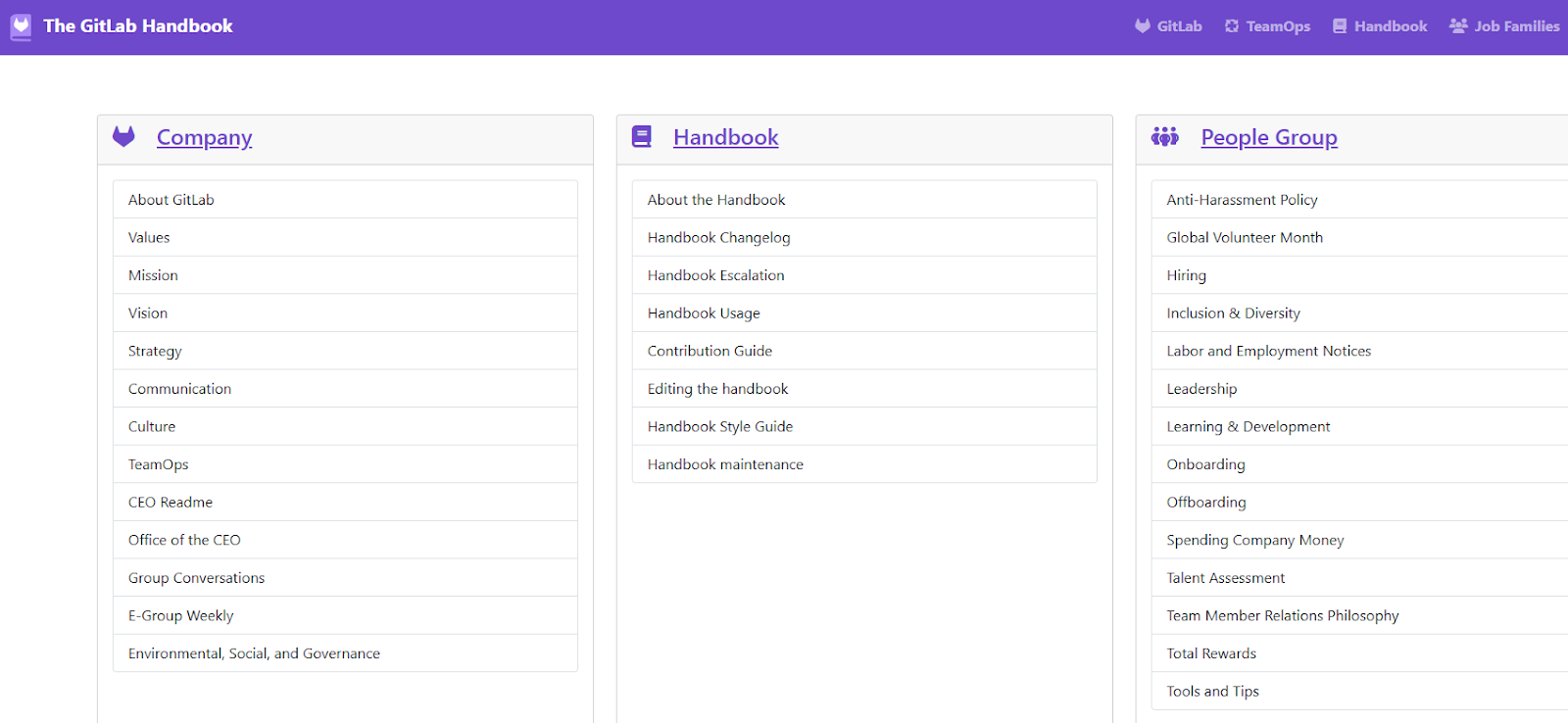
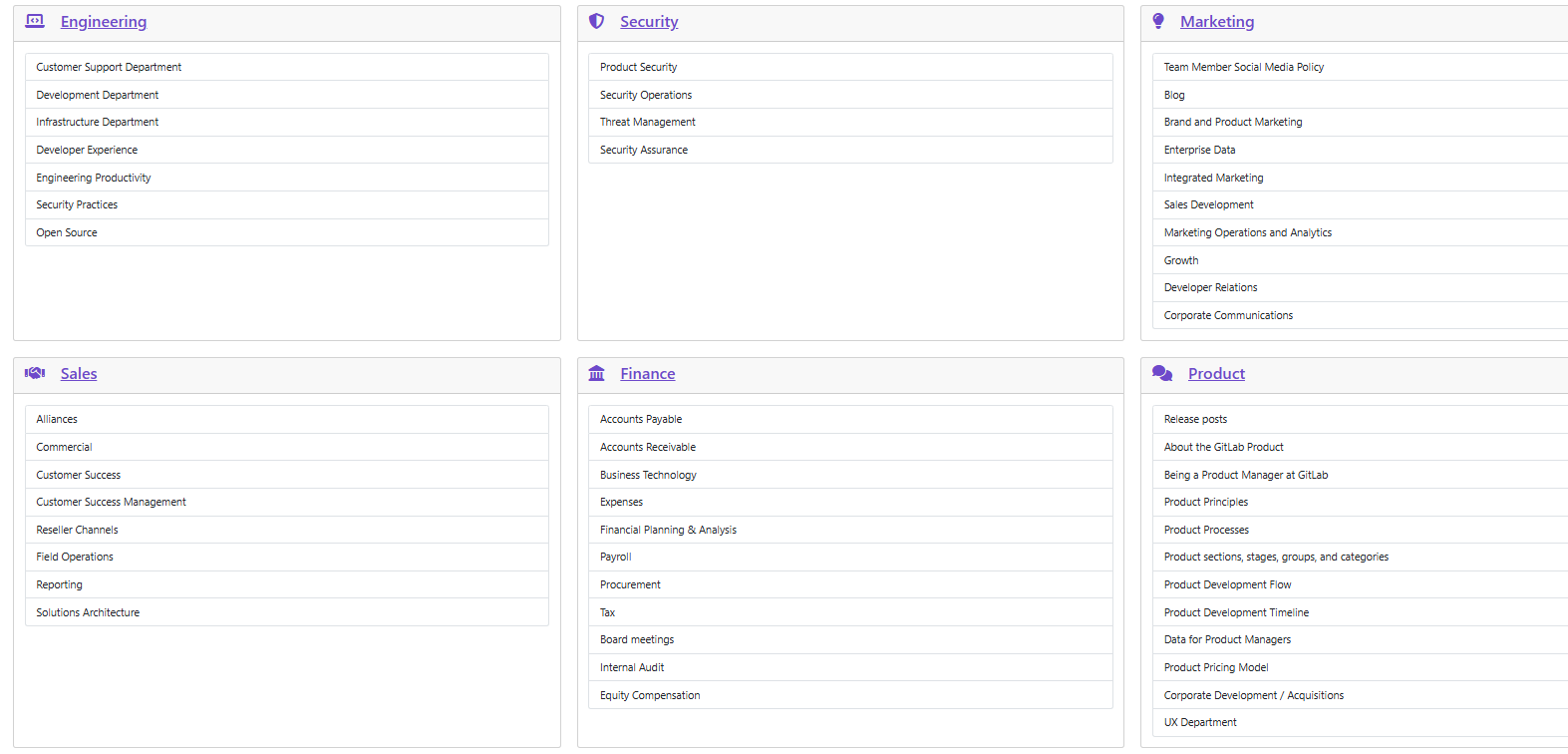
A glimpse into the GitLab Handbook
Every process, divided by department is described there. GitLab has a handbook-first culture – Any change (process, policy, or decision) must be documented first before being communicated or implemented. When employees have a question, they are advised to look for the answer first in the handbook. This is how the dependency on real-time communication is reduced. And it works!
Additionally, every team’s quarterly targets are thoroughly documented and accessible throughout the organization. GitLab conducts monthly reviews of these “objectives and key results” (OKRs), demonstrating how the company puts its commitment to transparency into practice internally.
Now, oftentimes we hear this counterargument for hiring remote employees: it’s difficult to handle onboarding.
Well, not for GitLab.
GitLab recognizes the strategic benefits of remote recruitment beyond just gaining an edge over competitors. The remote hiring process often moves more quickly, with virtual assessments and interviews providing excellent cost efficiency. By tapping into talent pools that traditional companies might miss, GitLab has built a team that’s both genuinely diverse and highly skilled. The company is experiencing tangible returns from this approach to staffing.
When integrating new personnel into your distributed workforce, GitLab recommends these actionable strategies:
- Develop comprehensive documentation. Maintain all procedures, tutorials, troubleshooting resources and guidelines in a unified, easily navigable repository (aka “The Handbook”). This enables recent hires to source information independently and cultivates self-sufficiency.
- Foster inquiry through openness. While transparency about organizational developments is essential, actively encourage new team members to raise questions. Cultivate a space where curiosity is valued, particularly during initial onboarding.
- Cultivate interpersonal relationships. Remote arrangements can feel disconnected without deliberate planning. Enhance workplace connections by dedicating resources to team bonding activities that assist new employees in forming meaningful relationships with teammates.
- Implement consistent feedback loops. Arrange weekly individual meetings between supervisors and new team members to address concerns, recognize obstacles, and develop rapport. Supplement these professional discussions with informal conversations focused on personal connection.
If you want to dig deeper into GitLab’s hiring process, here you have all the info you need.
Airbnb’s “Live and Work, Anywhere” Program Led to a Drop in Employee Turnover

During the development of their work approach, listening for the employees’ perspectives was crucial. By responding to these insights, Airnbnb achieved a reduction in staff departures alongside unprecedented levels of employee advocacy.
The Airbnb “Live and Work Anywhere” initiative recognized that arbitrarily requiring thrice-weekly office attendance isn’t effective. Various departments operate on distinct schedules—finance teams may need collaboration during month-end closing periods, for instance. Each group has its own operational cadence.
Furthermore, home-based work isn’t universally preferred. Consider someone residing in a compact London apartment who might lack adequate space for a comfortable home office.
This is why Airbnb built its program based on 5 pillars:
- Employees can select their preferred workspace
Airbnb allows team members to determine where they work best, optimizing individual effectiveness. While this option exists for most positions, certain roles require physical presence to fulfill essential responsibilities.
- Employees can relocate within their employment country without compensation adjustments
Staff can move anywhere within their country of employment with no salary impact. Beginning in June, the implementation of country-specific compensation frameworks ensures location-neutral pay structures.
- Employees can combine travel with remote work globally
From September 2022, Airbnb enabled remote work across more than 170 countries for up to 90 days annually per location. Though maintaining a permanent residence remains necessary, the company collaborates with governmental bodies to streamline processes, though ultimately employees must secure appropriate work authorization.
- Employees participate in periodic in-person collaboration
Acknowledging the value of face-to-face interaction, Airbnb cultivates community through scheduled team assemblies, retreats, and community events. Certain positions, particularly leadership roles, may require more frequent in-person engagement.
To optimize the effectiveness of major face-to-face events, Airbnb has established a specialized “Ground Control” team. Their mission is to thoughtfully organize meaningful connections among the employees at optimal times.
The philosophy centers on planned interactions delivering superior outcomes, with defined objectives, and structured programs.
- Employees operate within a highly synchronized framework
To support workplace flexibility, emphasis is placed on organizational structure and coordination. All activities revolve around the company’s multi-year strategic roadmap. The calendar features biannual major releases (May and November), with in-person gatherings scheduled around these milestones to ensure alignment.
Prior to COVID-19, approximately 95% of Airbnb’s workforce resided near corporate offices. Today, nearly 25% of employees live more than 50 miles from any company location.
Following the launch of Airbnb’s initiative, roughly 20% of employees have either moved within their home countries or performed their duties from international locations.
Employee satisfaction metrics are growing steadily.
The company has documented a substantial increase in employee turnover, approaching historically minimal levels. Furthermore, their “Live and Work Anywhere” approach is advancing their diversity objectives, helping to bring more women and professionals from underrepresented groups into the organization.
Conclusions
The 2020 pandemic forced many companies to work remotely, at least for a couple of years. Presently, there seems to be a big push for return to office mandates.
But, there are companies out there that turned remote hiring into their competitive advantage.
Companies like Dropbox, Atlassian, GitLab and Airbnb have built diverse, high-performing teams through location-independent hiring while reducing turnover.
What they are teaching us is the fact that success requires intentional practices: comprehensive documentation, regular check-ins, social connection opportunities, and coordinated gatherings.
Rather than enforcing rigid schedules, these organizations empower employees to choose their work environment while maintaining alignment through clear roadmaps and thoughtful in-person collaboration.
The key to their success: the right people managing through the right processes :).